

We’re sharing some of our favorites from the Praxis archives here on Praxis Press. The following essay is adapted from a plenary talk Andy Crouch, Praxis Partner for Theology & Culture, shared at the 2022 Redemptive Imagination Summit.
Technology is a major part of the story we are living in and responsible for as redemptive entrepreneurs. Many members of our community work directly in tech ventures, and more broadly, we all depend on technology in our professional and personal lives. And yet technology prompts a great deal of ambivalence even in those who build it and benefit from it.
Many of us sense, at the very least, that we need to be thoughtful and intentional about the devices and systems we are building and adopting—that technology is not in fact “neutral” but can sometimes actively undermine human flourishing, even when in other cases it seems to bring great benefits.
The moment you question any given technological development, though, you run into a powerful implicit idea, an idea whose ability to impede healthy thinking and reflection is matched only by how totally it is taken for granted most of the time. It is the belief that the story of technology fundamentally advances along one single line from “primitive” to “advanced.”

From the basic tools developed early in human history, through the machines, devices, and platforms available to us today, and continuing on into an imagined future, this progression seems like it is going one direction. To call into question what is happening as it occurs seems futile: “the genie is out of the bottle.” There are more genies about to come out of more bottles, and to raise any questions about this proliferation of genies seems to amount to saying that we want to go back to a previous point on a linear timeline of progress.
I think this assumption is mistaken.
Two stories of technology
There is not just one story of technology playing out in the world—there are two.

The first is the ancient story, coextensive with human history, of tools, through which human beings extend our heart-soul-mind-strength capacities in the world. Initially, tools extended our physical strength, but eventually, tools like pencils or typewriters extended our mind through the ability to write down and work out thoughts. We can extend our hearts using musical instruments.
This story has been playing itself out from the very beginning, and continues to play itself out to the present day. We continue to find new ways to extend our heart-soul-mind-strength capabilities.
What is new—at least in some ways—is a second story.
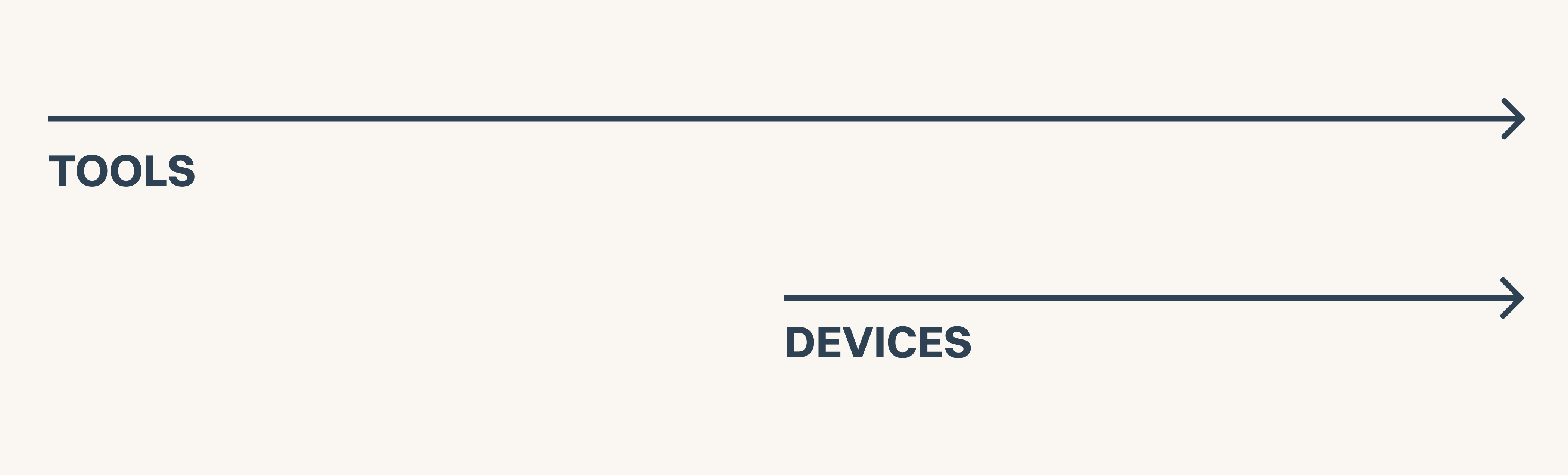
This chart is not to scale, because the first story is tens of thousands of years old, while the second story—borrowing the language of the philosopher Albert Borgmann, the device story—is a very recent development. In software terms, we’d call it a “fork” in our cultural and social operating system, introduced into the collective human repository a mere hundred or so years ago.
What separates tools from devices can be stated plainly: tools require and reward human involvement, while devices bypass and replace it. Human beings use tools, and tools are used by human beings. But devices are distinguished by the fact that as they progress, they require less and less human involvement to operate.
They are built on two great discoveries: sources of autonomous power that do not depend on human or animal bodies (above all hydrocarbons, their latent power channeled initially through steam and then electricity and eventually electronics), and what we broadly call cybernetics, the ability to create self-governing systems that modulate their own action in response to the world around them. By harnessing autonomous power and cybernetics, devices set themselves free of us and start operating on their own. We don’t use devices in the same sense that we use tools.
This story, like the tool story, is also “progressing” in that devices are becoming more and more autonomous, more and more impressive, over time. And this story is playing itself out at the same time as we continue to extend human capabilities directly through tools.
The big difference is that as tools improve and advance, human skill also improves and advances. But as devices improve and advance, human skill becomes less and less required, to the point of atrophy, as the world begins—beautifully and perhaps magically?—to operate on its own.
The Innovation Bargain
Both of these stories involve trade-offs: choices we make about what is good, what is better, and what good things are worth giving up for some better thing.
I propose we call this set of trade-offs the Innovation Bargain. It identifies a set of consequences that come along with almost every tool and device.

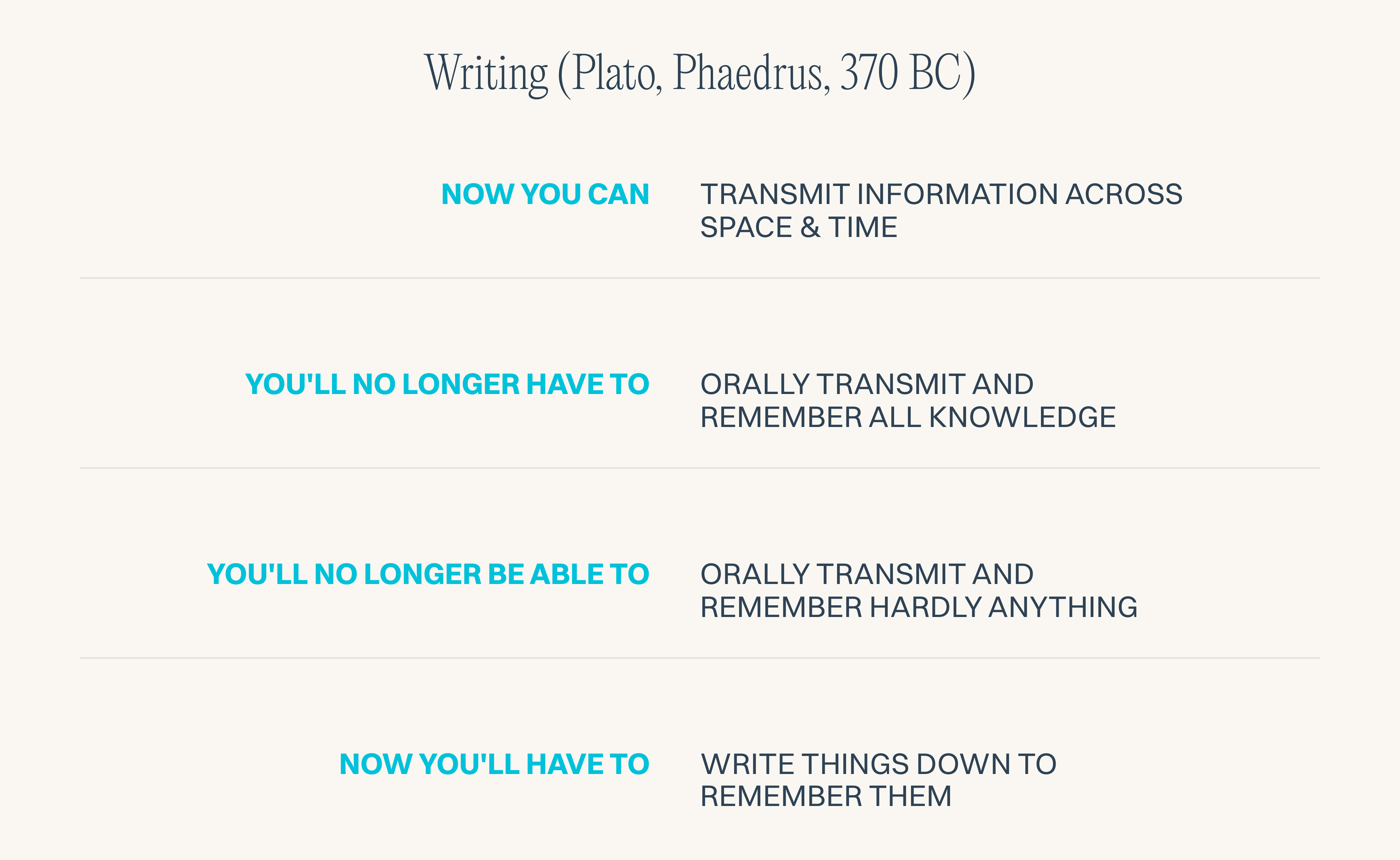
We adopt most every innovation on the basis of two basic promises. Now you can . . .do something that you could not do before. And also, quite often, You’ll no longer have to . . . do something that you could not avoid before. You’ll have a new capability, not previously available, and also a new relief from burden.

But innovation is a bargain because there are two further consequences of many things we bring into the world. It turns out quite often that once an innovation has become fully embedded in our world and invested with cultural power, it also becomes the case that you’re no longer able to do some things that you could do before.
Consider the invention of automobile highways. I’ve spent most of my life living in the cities of Boston and Philadelphia and a fair amount of time traveling between them. Our predecessors in this country would have had no problem riding a horse from Boston to Philadelphia. For roughly two centuries that was a fairly normal activity. I dare say that activity is quite impossible today (aside, possibly, from recording some kind of colonial-reenactment reality television program). You are no longer able to ride a horse between these cities. Something that was totally possible has now been closed off by many new tools and devices, from asphalt to automobiles.

And there is a fourth element in the bargain: Now you’ll have to. Certain kinds of compulsion arise that we may or may not have anticipated when we began the process of innovation and adoption.
Humanity’s awareness of this bargain goes back a very long way. Its most famous early articulation comes from Plato’s dialogue Phaedrus, composed in the fourth century before Christ, where Socrates tells a story of the invention of writing. The inventor, the Egyptian god Thoth, brings his invention before King Thamus, who admits that Thoth’s invention is impressive and does indeed relieve human beings of having to orally transmit and remember all knowledge. But, Thamus observes, this also means that you’ll no longer be able to transmit or remember hardly anything without writing.
And indeed, the human capability to hear complex discourses and remember them with high fidelity, as documented in Richard Bauckham’s fascinating book Jesus and the Eyewitnesses, has been utterly lost today—as you can see at any presentation as the audience holds up their smartphones to capture an image of even the simplest slide that they want to remember.
Writing, insofar as it extends our human capacity for reason, memory, and more, is utterly in the realm of tools, not devices (at least until the latest generation of AI models started being able to produce human-like writing). So the story of Thoth and Thamus reminds us how tools, as well as devices, involve the trade-offs of the Innovation Bargain to some extent. We, as a literate society, have simply made the judgment that the bargain was worthwhile in this case—just as we have in almost every other case.
The path and the highway
In an influential essay called “A Native Hill,” the writer Wendell Berry illustrates an important further dimension to these bargains. With Berry’s help, we can observe that not all innovation involves the same form of the Innovation Bargain.
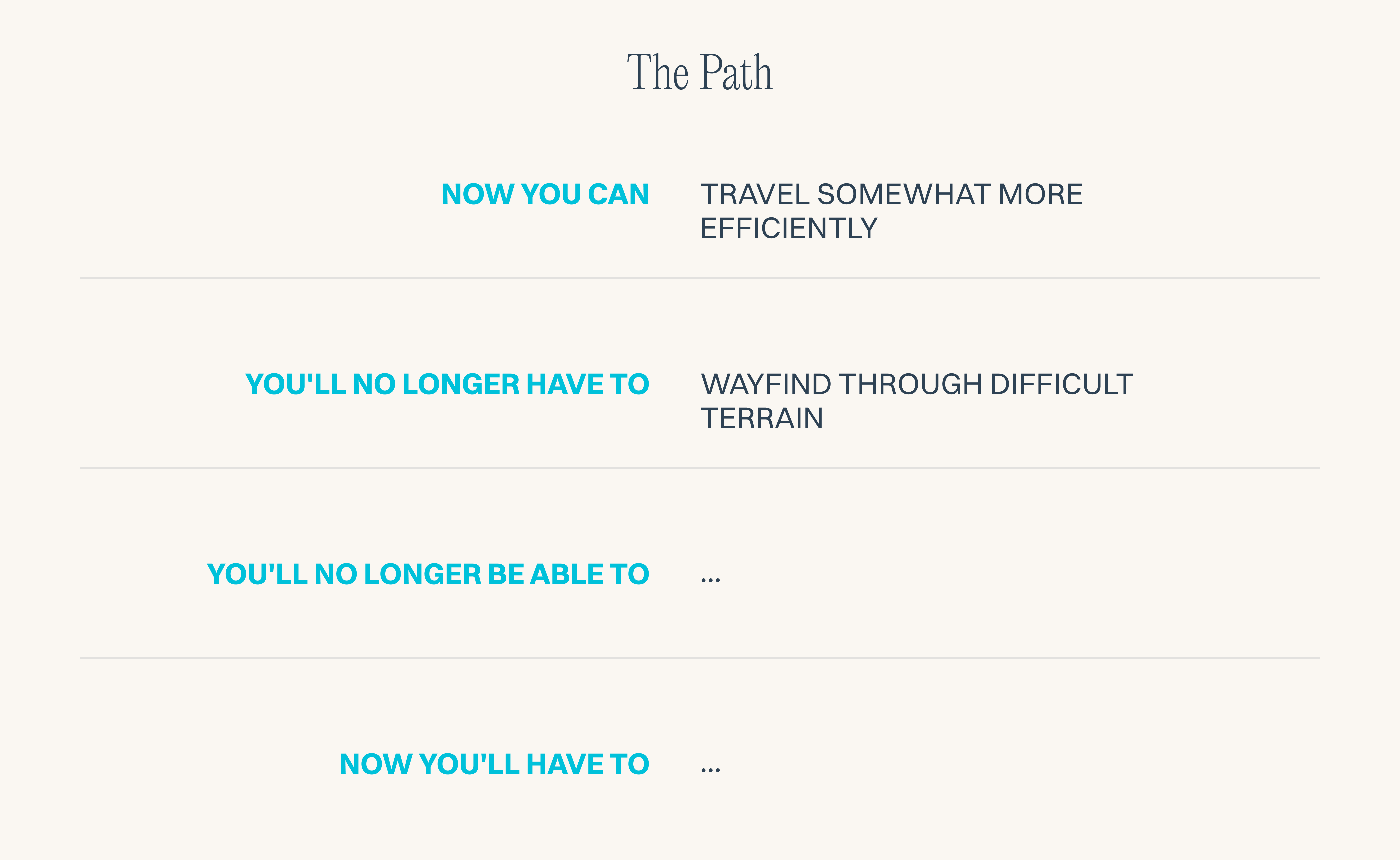
Berry first identifies, on the one hand, a path, worn by the passage of many human (and perhaps non-human) feet. A path allows us to travel more efficiently than we could before (in the terms of the Innovation Bargain, “Now you can . . .”). And it relieves us of having to bushwhack through difficult terrain (“You’ll no longer have to . . .”). These are real advantages.
But, interestingly, the path imposes very little of the other side of the bargain. When you are walking on a path, what is it that you’re no longer able to do? It’s hard to think of many activities that are foreclosed by the presence of a path through a woodland or meadow. And it doesn’t seem that the path enforces many activities, either. If you want to leave the path, that’s fine. It is not very coercive. It seems to expand our capabilities in the world without making many corresponding demands.

Berry contrasts this with what he calls the road, though for my purposes I will call it the highway (and indeed, the road Berry is dealing with specifically in his essay is I-71, a US Interstate Highway). A highway makes many of the same promises as a path. It also offers efficiency of travel, though it allows for far greater efficiency and speed than any path. And likewise it relieves you of having to wayfind slowly through difficult and perhaps unfamiliar terrain.

But the highway is not as consequence-free as the path. It imposes a steeper bargain on the human beings who pass through the environment it reshapes (and, of course, a steeper bargain on other creatures and the environment itself). Once there is a highway, it is harder to wander and explore on foot.
We may, indeed, set out to explore a new neighborhood in a city or town and find ourselves running up against physical barriers that prevent our crossing them—or, perhaps more often, the emotional barriers of traversing under forbidding elevated structures or trying to make our way across several lanes of fast-moving traffic.

And of course, to take advantage of a highway you have to purchase and maintain an automobile. It does not offer its advantages to all comers, but only to those able to muster the financial resources to join the car-based economy of the modern world.
Both the path and the highway are innovations. But one offers new possibilities while imposing very few trade-offs. The other imposes trade-offs that are quite substantial—though ones that we, as a highway-building society, have collectively decided are worthwhile.
The dream of superpowers
Such trade-offs go back a very long way in the human story, and in the stories we tell to make sense of the world we find ourselves in. Not all of them turn out so well.

Eat the fruit, promises the serpent in Genesis 3, and you’ll be able to know good and evil. Sounds great! Furthermore, you’ll no longer have to depend on God for such knowledge. Indeed, if we could be like God and know good and evil independently, why not? So the bargain is accepted, though it comes with a few previously undisclosed items:

You’ll no longer be able to see the face of God and live. Now, apparently, you’ll have to wear clothes to cover your human shame. And various other terms and conditions apply.*
*Thou shalt work the earth by the sweat of thy brow, in toil shalt thou eat of it all the days of thy life, in pain thou shall bring forth children, thou shalt desire thy husband and he shall rule over you, thou shalt return to dust for dust thou art and to dust thou shalt return.
Other than that, a fine bargain.
Genesis 3 tells a story, the paradigmatic story in the Jewish tradition, of a bad bargain. We were dreaming of something that might expand our capabilities, but it turns out, according to the story, that that expansion of capabilities came at a terribly high price, bringing new dimensions of coercion into the world—not just us being coerced to do things we would rather not do, but us coercing one another to survive and make our way through a world made less good for human flourishing.

And this suggests to me that in some ways, the new story of devices is actually a very old story. It traces back to the human desire to do magic—the human desire to have powers beyond (to borrow a phrase from Alan Jacobs) our own “proper powers.” To exceed the place we have been given in the world, to exceed the heart-soul-mind-strength constitution we have been given, to reach beyond and start seeing the world magically operate with effortless power.
This is a very ancient dream—it’s just that we couldn’t actually realize it until roughly one hundred years ago. And this dream has a telos, a direction it is going, which has recently been given a name, a word more and more commonly used in the promotion of the newest digital services. The end state of the dream of magic is superpowers.

Not just ordinary power raised to a greater extent (the kind of extension of human abilities afforded by tools) but the ability to transcend my given limits, to do astonishing things with very little apparent effort.
This is in fact an ancient dream—with some very steep trade-offs attached.
When we see it at its worst, we recognize it for what it is. Not long ago one publication named Pornhub the “third most influential tech company” (after Facebook and Google, but ahead of Microsoft, Apple, and Amazon), and that company is just the largest commercial instance of the many-headed hydra called porn, which offers us a classic case of the Innovation Bargain at its worst.

With porn’s help, now you can have the sensation of erotic intimacy whenever you want, and you’ll no longer have to form and consummate a relationship to experience it. Superpowers, certainly.

Then again, a raft of psychological and social data suggest that once you personally are entrenched in porn and once your society is entrenched in porn, you’ll no longer be able to form and consummate a relationship. And now you’ll have to continually increase the “dosage”—frequency, quantity, intensity—for the same effect.
Other terms and conditions may apply, some of which may be yet unseen and not at all reckoned with. Once this innovation bargain has been made, all kinds of coercion enter the world—new forms of violation and violence that were all but unthinkable before.
And we thought we were just getting a new superpower.
The innovation of instruments
We need to be very cautious indeed with this second story, the ancient dream of magic which leads to the modern reality of devices and the ultimate fantasy of superpowers. Not because all devices are bad in their proper place. They have real contributions to make to human flourishing. But the dream behind them is dangerous—and in any case, there is another, better story, and the fullness of that story is still waiting to be told.
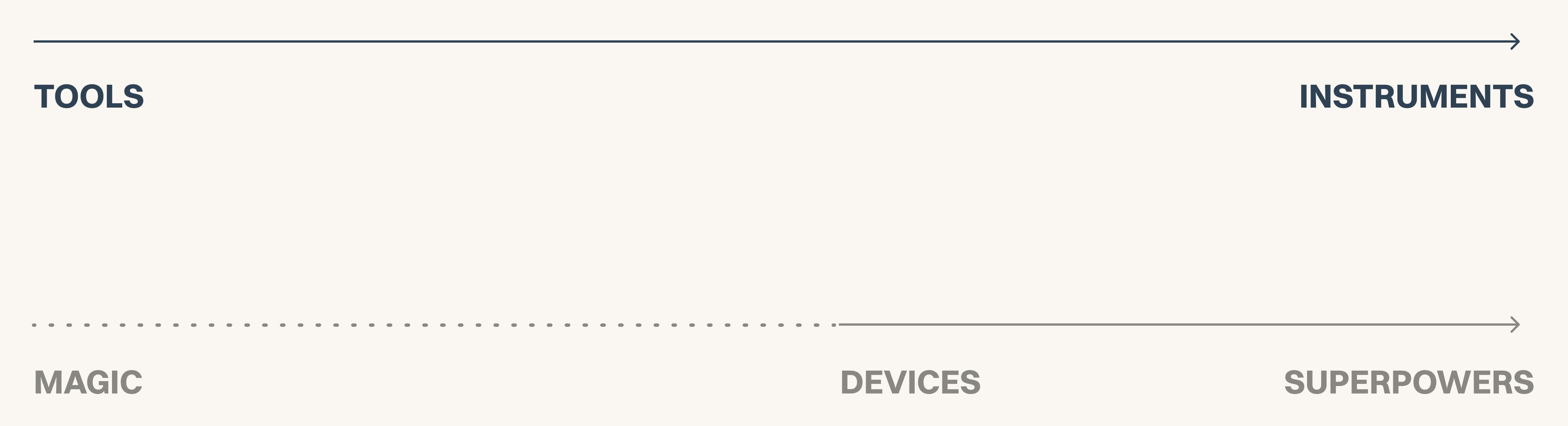
In The Life We’re Looking For, I describe this as the story of tools to instruments. It is indeed about extending human capabilities, but without displacing or replacing people. Instruments—musical instruments, medical instruments, scientific instruments—do not take the person out of the loop. Instead, in more and more powerful ways, through the application of all that we have learned about the world and indeed ourselves, they put the person back into the world—ideally, as nothing less than an image bearer of God.
This story is not finished. This story could have a long way to go. And this story is the proper application of all that we have learned from science, while also helping human beings fulfill our calling to be image bearers rather than the idol makers and image breakers we have become.
In our community at Praxis we already have many entrepreneurs pursuing this kind of innovation. They are subject, of course, to the same Innovation Bargain as all innovations are, but as with the path compared to the highway, the trade-offs are far better for human beings and for the world we inhabit.

The app Lasting, created by a team led by Praxis Fellow Steve Dziedzic (Business 2018), had been selected as one of Apple’s Apps of the Day for Valentine’s Day and has helped 3 million couples to date strengthen their relationship (and, with a more recent companion app, their parenting).
They sign up because of a compelling now you can—increase trust by addressing the hard issues in a marriage, using proven relationship-building strategies—and you’ll no longer have to—pay for expensive couples’ therapy. Ninety-four percent report stronger relationships after using the app—a distinctly instrument-like contribution to genuine human flourishing, in that rather than making hard things “easy,” Lasting helps facilitate the personal and relational growth that makes hard things possible.

And what are the trade-offs to using Lasting, other than its relatively affordable price? Having tried it with my own wife, I suppose it is true that you’ll no longer be able to pretend everything is fine in your marriage—Lasting guides you into the deep waters you need to navigate together. For now you’ll have to, though, I am stumped. I suppose Lasting does make it harder to give up on a marriage altogether. So, now you’ll have to . . . stay married?
As Innovation Bargains go, this is a good one.
There are no superpowers for marriage. There are no superpowers for any of the most important aspects of our lives. The magic we have been chasing actually undermines all of the most important things, all of our highest callings as heart-soul-mind-strength complexes designed for love. Why not build for the real work of being human, rather than the illusion of being superhuman?
And in fact, that is what many in our community at Praxis are doing. Almost invariably, when you examine the tech our community is developing—from new patient-provider interfaces to cutting-edge hydration detection to e-commerce for neighborhood stores, to pick just three examples from our 2022 class of Business Fellows—the focus is on instruments and heart-soul-mind-strength engagement with the world.
We just need far, far more of this.
There are two stories at work in the world. Augustine called them the “city of God” and the “city of man.” We could call the two stories the image bearers and the image breakers. They map onto these two stories, of tools to instruments and of magic to superpowers.
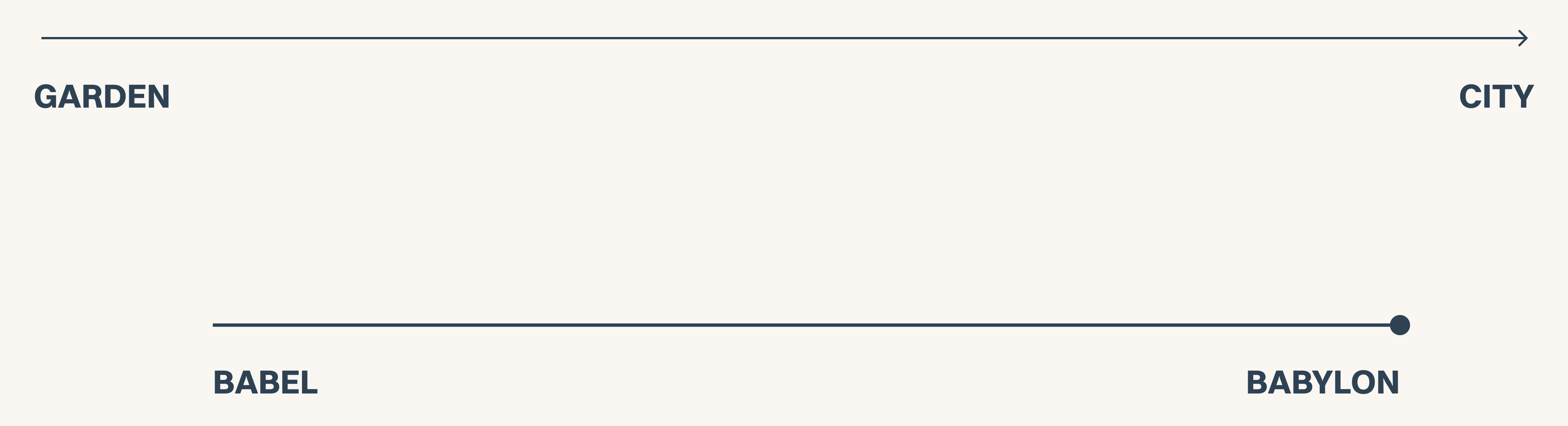
One of them is the story of the Garden to the City, Eden to the New Jerusalem, Genesis 2 to Revelation 21. I would argue it is the truest and most hopeful story, and—at least so Christians believe—it extends into eternity.
The other is the story of two impostor cities, impressively audacious but ultimately deranged and undermined by their detachment from the true human purpose and the nature of the cosmos itself. While it is still going on, it is a story that will assuredly—as even the most secular will admit—come to an end. Very possibly a bad end.
While we still have time to choose, why not build our technology for the story that will last?

Thank you so much for this article. I love how you walked us through the two stories and then mapped them onto the Garden-to-City and Babel-to-Babylon narratives. I am going to be chewing on this for a while.
Excellent article guys. Thank you. The issues is on my mind as I interact with people who struggle with suffering and human purpose.