

We’re sharing some of our favorites from the Praxis archives here on Praxis Press. The following essay is adapted from a plenary talk Andy Crouch, Praxis Partner for Theology & Culture, shared at the 2022 Redemptive Imagination Summit.
An entrepreneur, in essence, is a process innovator with a high tolerance for risk—someone who is willing, or indeed driven, to find a new way to live and work in the world while accepting the possibility or even probability that their new way could fail.
At Praxis, we focus on three dimensions of work. There can be risk-tolerant process innovation in the area of strategy, the goods and services we aim to produce in order to create and capture value, and equally often in the axis of operations, the processes and systems we deploy to see that strategy enacted.
But in many ways, the most fundamental axis is that of leadership, or the deep story by which founders and builders live and make their most important choices. That deep story is at the root of process innovation. So often strategy and operations emerge out of the entrepreneur’s own imagination, rooted in explicit and implicit dreams and assumptions about the direction of our life.
While our society tends to notice and celebrate the innovations in strategy and operations, reshaping our inner story is, in a sense, the ultimate process innovation—and because we generally have very good reasons for holding on to the stories we have been living by, any dramatic change in one’s inner story always involves an element of risk.
Reshaping our inner story is the ultimate process innovation.
Certainly this was true for the character who may be properly seen as the Bible’s Ur-entrepreneur: the scrappy, clever, innovative, and successful nomadic herdsman named Jacob.
Jacob’s ambition, famously, begins even before birth, which gives him his name, “the one who grasps,” as he emerges grasping onto his twin brother’s heel, wrestling for first place. Jacob’s great ambition in life is to gain the birthright that eluded him at the beginning.
He is nothing if not entrepreneurial in his pursuit. As a young man, he’s cooking a stew when his older brother Esau comes into the tent famished from his work in the fields. Jacob makes an Innovation Bargain with him. Now you’ll be able to eat right away, you’ll no longer have to be hungry, at the small price that you’ll no longer be able to exercise your birthright. It’s a bargain that Esau, in his hunger, is willing to take.
At the end of their father Isaac’s life, when Isaac can hardly see, comes the time for the patriarchal blessing. The father’s hand on the son’s head, the words that will set the son’s course toward prosperity. And against the odds, with impressive innovation under pressure, and with a certain utilitarian indifference to justice and the truth, Jacob gets the blessing. He would make a great founder.
Not long ago a venture capitalist said on Twitter, “Elon Musk is divorced. Jeff Bezos is divorced. Bill Gates is divorced. For now on, I’m only investing in people who are getting divorced.” He was joking—I think.
In Jacob’s case, though his ambition does not lead to marital divorce, it does lead to rupture, serious enough that he and his brother decisively part ways. And then comes a day when Jacob realizes that the decades of distance are about to end. The gap is closing. Esau is approaching, with who knows how many men with him.
Jacob, who has amassed his own retinue over the years, starts sending gifts ahead, flocks of sheep and goats, trying to overcome what cannot be undone. Eventually he has sent everything ahead, and he’s left alone by the ford of the Jabbok.
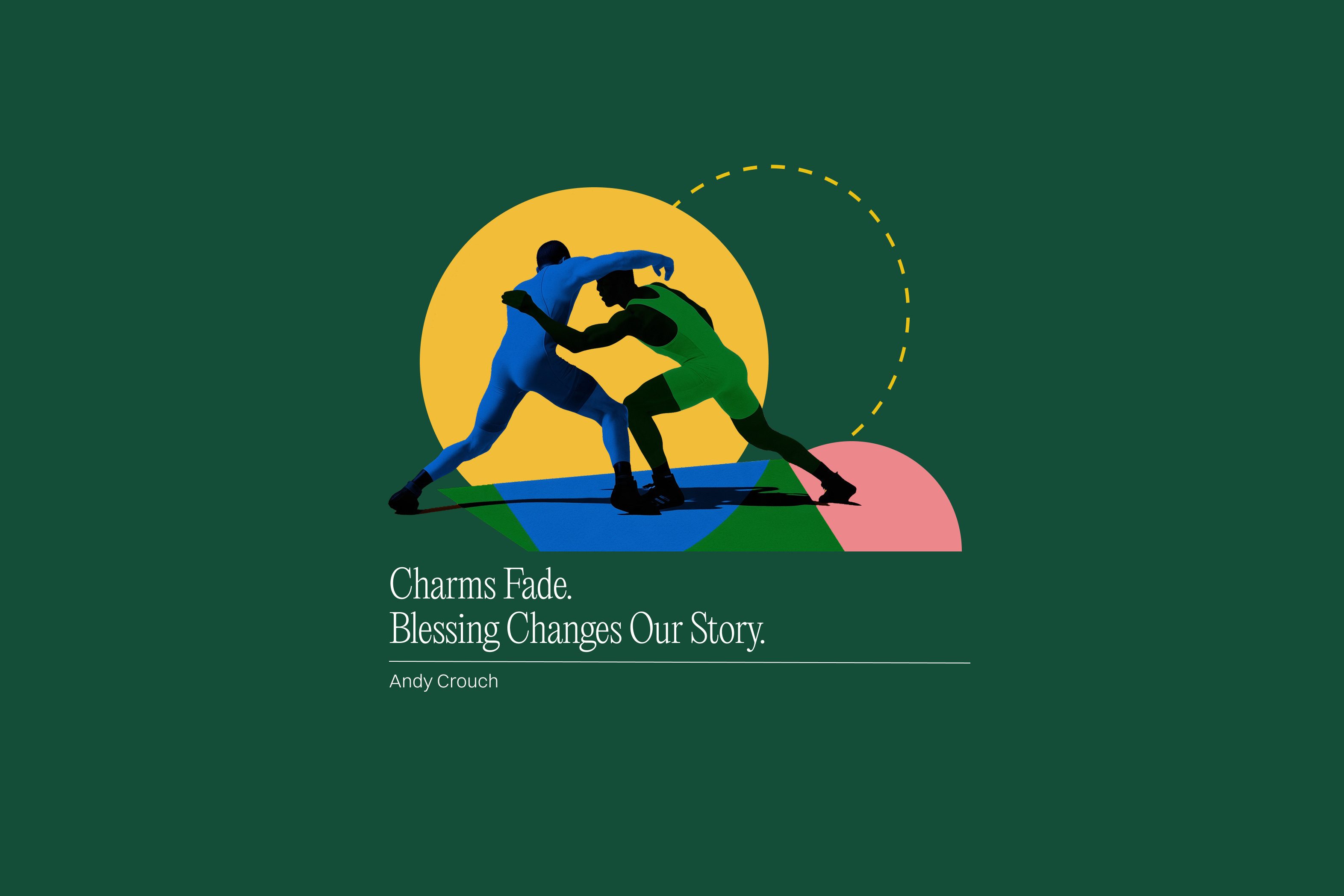
That night, a man comes and wrestles with him. The wrestling match ends at dawn with a blessing and a brief tap on the hip, so that the man who relied on his charm will for the rest of his life walk with a limp.
And with the wrestling match by the Jabbok, something changes in Jacob’s story. He’s given a new name, for one thing. His original name meant “he who grasps”—grasping the heel, going for the brass ring, striving for first place. His new name, Israel, means something like “he who strives with God” or “he wrestles with God”—or, equally possibly, “the one with whom God strives.”
“I have seen God face to face and lived,” Jacob says.
But who is God exactly? How much does Jacob really know of the God of his grandfather Abraham, the Fear of Isaac? This is just Genesis, after all—just the beginning of a very long story that will change everything we might have assumed about the one we call “God.”
If you keep reading Genesis, the conflicts in this story are by no means all wrapped up by the end. Esau and Jacob meet, briefly. They share a strained conversation. And then Esau leaves. The brothers never return to one other. The rupture is not really repaired. Jacob’s own sons will go on to replay his life’s drama, the competition to get into first place, the quest to be the favorite brother, a story with its own fraternal violence and its own uneasy, partial reconciliation at the end.
This story, we now believe, is the beginning of a much longer story than Abraham, Isaac, Jacob, and Jacob’s sons could imagine. This story would culminate in the firstborn of all creation becoming one humbly born, emptying himself, not grasping anything, taking on the form not just of a younger brother but of a slave, humbling himself even to death on a cross.
Who was it that Jacob was wrestling with? Was he wrestling with that very One whose story was going to be the absolute inversion of his story, the untelling of Jacob’s story—the One who, instead of grasping everything, would grasp nothing? Was Jacob wrestling with the One whose obedience unto death would repair all the rupture of the world?
Who are you, God? Is this what you are like? Is this who you are? And if this is who you are, what does that mean for who I am?
One of the great gifts of my life was my friendship with David Sacks, who died of cancer when we were both 45 years old. He was an artist, a creator, a builder, and a very, very good friend.
David, his wife Angie, and their four children were creative, charismatic people whose lives overflowed with opportunity and abundance. Then came David’s diagnosis in 2011. For about a year, medical technology made a real difference, extending David’s life far beyond what we could have initially hoped. But even the best charms wear off.
In April 2013 came the last week of David’s life—also the most amazing week of my life, in some ways, to this very day. Because David and Angie invited my wife, Catherine, me, and just a handful of others into their master bedroom, where David lay in bed, silent and weak. We prayed and waited and sang and waited.
I drove the mile back to our home by myself several nights that week. Some of those nights, I raged at God. I have mostly disciplined myself, I think for good reasons, such that with other human beings I almost never use profanity. But I at certain moments, alone with God, I do.
The last night, however, as I drove home, I suddenly found myself saying aloud, “God, this is blessing. I don’t think I’ve known what blessing was before. I’ve never been this close to suffering and to death. But I’ve also never been this close to blessing.”
I realized that night that all the things we often tag as “blessed” have little or nothing to do with blessing. They’re just charms.
David’s life had been charmed in many ways, a fortunate life, a prosperous life, an enviable life. My life, too, has been charmed, even to this day. But charmed is not the same thing as blessed.
What is our story, charmed or blessed? And if we have been living the wrong story, who will teach us the true one?
All the things we often tag as “blessed” have little or nothing to do with blessing. They’re just charms.
There are people who are not charmed—never have been and never will be. We need these people in our lives. There are countless people—among them infants, elders, the very sick, the profoundly disabled—who do not contribute “productively” to our world of money and power.
Anyone who is ethically serious knows that each one of them deserves our love and our help in living as full a life as they possibly can. They are fully human, image bearers. Love requires that we invest anything we can for any such persons, as much as is within our power, so that they may flourish.
But they do not just need our help. We need theirs. It is precisely the uncharmed, the uncharming, and the uncharmable who have something all of us need. At their side and in their presence, there is something that we need, that our communities need, for real health.
One of the most demonic features of any society—I use that word demonic quite intentionally—is to exclude from view and from life those who are visibly dependent, those who are visibly bearing with suffering, as if we somehow could just wish away that level of difficulty and dependence.
It can be difficult to be in the presence of the uncharmed. It’s not efficient. It’s not very useful, sometimes, it seems. But those who have learned to learn from them testify that God is with them.
And if God is with them, perhaps God also will be with us. The charms in our life are, almost by definition, temporary. Youth is a charm. Beauty is a charm. Many things we grasp after, many things we chase with all our might, are charms. But the uncharmed know that there is something on the other side.
Year after year, we experience charmed moments in our lives, only to go back to wrestling. But everything hangs on what kind of wrestling we are doing—striving to grasp the heel to get ahead, or wrestling with the One who wants to give us a limp and a better name. All the energy and capacity of our life will ultimately be channeled in one of these two directions, shaped by the deep story we choose—or, if we are given grace like Jacob, the deep story that chooses us.


Andy's teaching on how we need, learn from, and blessed by people who aren't "useful" is so convicting, and so important. "There are people who are not charmed—never have been and never will be. We need these people in our lives." -- amen!
This is great, "I realized that night that all the things we often tag as “blessed” have little or nothing to do with blessing. They’re just charms."
Appreciate the perspective here, @andy crouch