

Praxis organizes around the major issues of our time, which we call Opportunities for Redemptive Imagination (ORIs). Within each, we see the possibility for alternative imagination, for Christians around the world to think differently and build accordingly.
The following redemptive framework on disability was authored by Alex Wolf, chief content officer at Hope Heals, and represents the vision of the Praxis team.
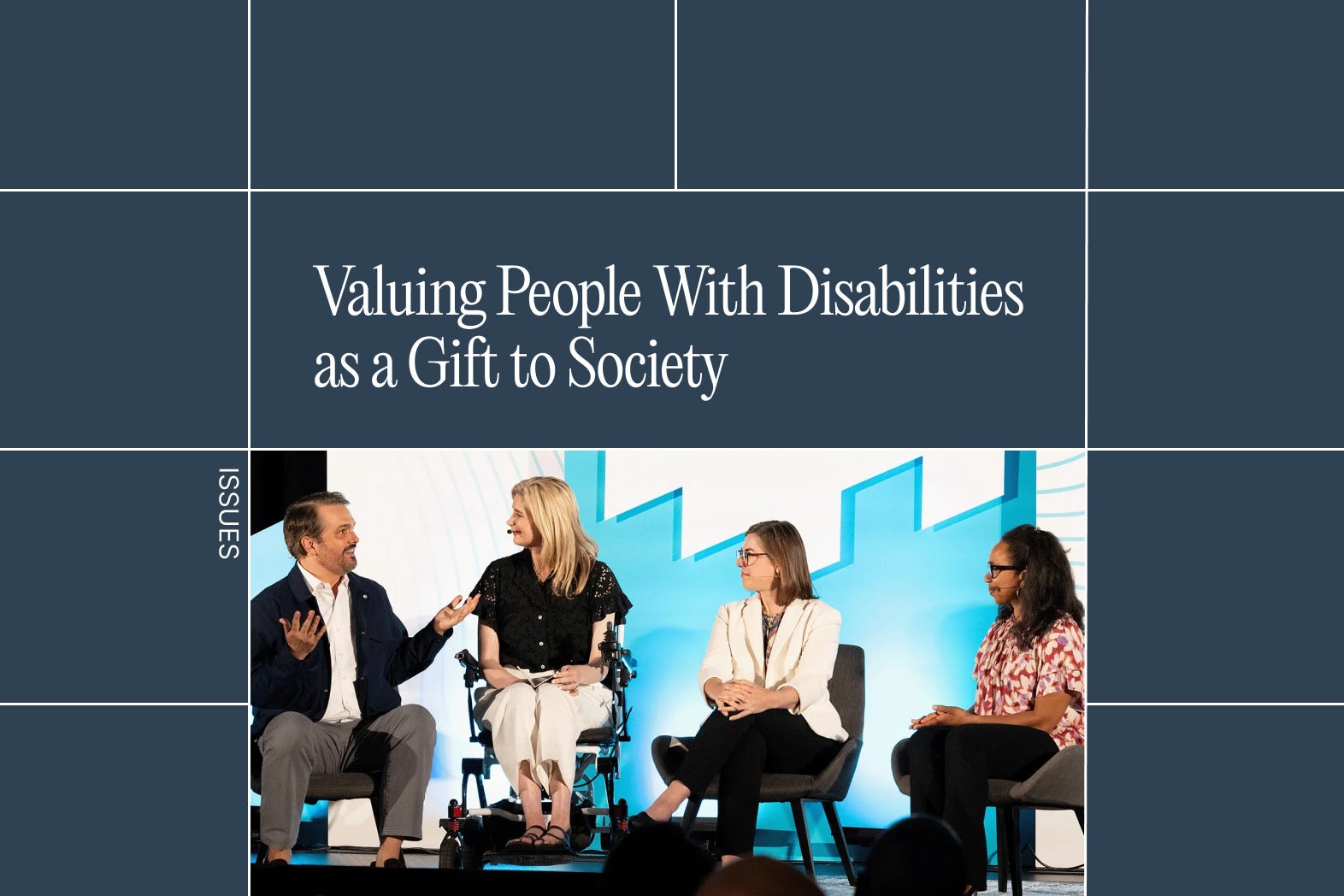
Our Reality: Living with Disabilities in a Market-Dominated World
Independence, self-determination, and prosperity are among Western society’s highest values. Each of these is predicated on the unfettered ability to decide, accomplish, and produce—and therefore all are, by definition, to some extent at odds with the experiences and identities of people with disabilities.
This demographic label describes the more than one-quarter of American adults functionally disqualified from full participation in our society’s value system. Exile to the margins of an independence-centered culture has resulted in outsized rates of unemployment, homelessness, divorce, depression, and suicidality among people with disabilities.
Disability is an umbrella term that encompasses a near-limitless collection of physical, intellectual, emotional, and behavioral conditions that limit or alter a person’s participation in the world. Notably, disability is a function of both how atypical one’s body and brain may be and the world one inhabits—including the physical, social, and economic structures of that world.
These two directions of disability—the person being suited or ill-suited for their environment, and the environment being suited or ill-suited for the person—can never be fully disentangled. Suffering, so often linked to disability, is the result of inhabiting systems that are not designed for certain types of brains and bodies.
People whose capabilities align at any given moment with social norms are likely to perceive people with disabilities as a distinct demographic group. The popular category of “special needs” reveals an assumption that people with disabilities have exceptional requirements for living, distinct from the needs of typical people. However, the fundamental needs of people with disabilities—bodily nourishment, safety, self-expression, spiritual enrichment, purpose, and a sense of belonging within relationships—are universal needs, regardless of ability. The needs of people with disabilities are not exceptional, though the ways in which they must meet those needs often are exceptional.
An undue focus on “special needs,” then, tends to distort our understanding of people with disabilities—and it also causes us to overlook their strengths. To be sure, if the only strengths that matter in human beings are those that contribute to market value, earning potential, and spending power, many people with disabilities may indeed be at a disadvantage. This can lead to those with disabilities being accounted for largely as liabilities in the public sector and irrelevant in the marketplace.
Because the marketplace assumes so little earning potential (and consequently so little spending power) from people with disabilities, investment in them can easily be seen as delivering minimal returns, whether the capital being invested is financial, infrastructural, or relational. This “return on investment” mindset has diffused from the marketplace into public services, relational networks, and even faith communities.
In the last three decades, legislation in the United States and many other countries has helped reframe accessibility as a human rights issue. Disability representation has advanced in workplaces, on campuses, and to some extent in popular media. This represents progress in healing the historic and ongoing neglect of those with disabilities. But to the extent that it takes place only within a narrow economic imagination—meaning that its aims are to equip people with disabilities to generate profit, earn wages, and spend more money—such inclusion will never fully address the needs of people with disabilities or fully tap into their strengths.
Living in proximity to disability invites us to acknowledge our common needfulness.
In fact, people with disabilities have distinct and irreplaceable gifts to offer society beyond their earning power. These gifts revolve around the profound and universal human need for belonging—which is more than merely being included or accommodated. Belonging is relational and reciprocal; to belong is to be simultaneously needful and needed.
Seen this way, disability is not a problem to be solved; it is a prophetic witness to our common humanity.
To be alive is to have needs, and this aspect of humanity is more fully alive in disability—the embodiment of our inescapable needfulness—than in typical or average ability. Living in proximity to disability invites us to acknowledge our common needfulness. The more widely that human needfulness and dependence are accepted, the more people can experience the gentleness and grace of a world built to accommodate need rather than eradicate it.
The reality of disability is an invitation to dismantle our false and narrow value system and reorder it according to the way of love, joy, creativity, contentment, humility, worth apart from achievement, and wholeness. And these truer, deeper values are frequently more readily found in the lives of people experiencing disability than in their typical counterparts. We all need more of what they have.
Valuing people with disabilities as a gift to society depends on fundamental transformation and significant sacrifice in our personal and shared narratives of what it means to build lives worth living. Offering the world as a place of belonging to people with disabilities requires reorienting ourselves within the framework of disability, re-evaluating our concept of the image of God, and reordering our shared value system in the way of love.
Valuing people with disabilities as a gift to society depends on fundamental transformation and significant sacrifice in our personal and shared narratives of what it means to build lives worth living.
A Redemptive Framework
When human needfulness, vulnerability, and dependence are recognized as universal experiences, the story of disability becomes more accessible to everyone. That is not to say that everyone is disabled, but rather that the category of disability is more porous than one might assume.
Disability exists as a spectrum, not a binary, and anyone at any moment could find themselves progressing along that spectrum. A typically abled person is actually a temporarily able person. If a person lives long enough, he or she will become disabled by disease, injury, genetics, or age. Indeed, the only alternative to eventual disability, in some form, is a premature and sudden death.
Fully reckoning with this reality should cure us of considering people with disabilities as a niche outgroup, as does the consideration that every person living with disabilities likely represents multiple family members, caregivers, and friends who are implicated in the effects of the disability even if they do not have a diagnosis themselves. Valuing people with disabilities begins by orienting all people within and around the spectrum of disability.
Even Jesus belongs within the story of disability. His incarnational life and ministry required that he be limited by a body, constrained by human language, tethered to time and space, and victimized by unjust systems of power. Jesus became vulnerable, dependent, and needful in order to meet our ultimate need for reconciliation with God.
By disabling himself through the Incarnation, Jesus dignified the reality of disability by becoming the most whole person who ever lived, even while living with limitations of cosmic consequence.
If the experience of disability can be found in the person of Jesus, then it follows that living with disabilities does not exclude a person from bearing the image of God. God is far too vast to be expressed in just one way or by just one type of person, and people with disabilities are a vital part of the diverse embodiment of God’s image through humanity. They are a countervailing force to our tendency to conflate the likeness of God with attributes like physical power, outward beauty, or intellectual acuity.
If we want to value people with disabilities sincerely, we must consider what type of world would allow them to give and receive love most freely and fully—and build according to that vision.
Recognizing God’s image in people with disabilities means reckoning with our small-minded and small-spirited conceptions of God’s character. Furthermore, if we agree that being made in the likeness of God endows every human with intrinsic and unearnable value, then we must acknowledge disability as an extra opportunity for—not a barrier to—experiencing our own value apart from achievement.
Each person has value because he or she is made in the image of God, and being made in the image of God includes giving and receiving love. If we want to value people with disabilities sincerely, we must consider what type of world would allow them to give and receive love most freely and fully—and build according to that vision.
A world organized on the giving and receiving of love would be necessarily characterized by mutual sacrifice, interdependence, humility, vulnerability, submission, and contentment. These are the makings of common good and common health. Paradoxically, the attributes of healthy communities stand in near diametric opposition to the values of independence, self-determination, and material prosperity. Valuing people with disabilities as a gift to society requires rebuilding our shared value system on the foundation of sacrificial love.
Opportunities for Redemptive Imagination
Since all human beings will interact with a flexible and changing spectrum of disability and dependence throughout their lives, each of us stands to benefit from reordering the world as a place of belonging regardless of ability.
While disability-specific ventures offer evident value to people currently affected by disabilities, the majority of the following opportunities for redemptive imagination will help all of us move toward a world where we systematically acknowledge human needfulness and build interdependent relational networks.
We therefore mostly focus on the possibilities for better serving people with disabilities within existing structures rather than multiplying niche disability programs. The thoughtful integration of diverse embodiments throughout all dimensions of human endeavor will allow everyone involved to witness more robust expressions of God’s image through the giving and receiving of love.
Inter-ability employment
People living with disabilities are twice as likely to be unemployed as people without disabilities, and the detrimental effects of chronic underemployment and unemployment extend far beyond financial instability. Fewer job options mean limited opportunities to contribute to shared work (fulfilling the human need for purpose) as well as limited access to the regular and organic social connections that workplaces provide (fulfilling the human need for relationships). We believe creating gainful employment tracks within existing enterprises for people with disabilities is a major pathway of redemptive action, especially when job generation is approached with creativity, flexibility, and empathy.
Alongside quantitative key performance indicators, companies committed to valuing people with disabilities as a gift to society must also identify qualitative key performance indicators, such as a sense of belonging, that do not obviously support the bottom line. Remaining accountable to those qualitative benchmarks means intentionally risking maximized profits, operational efficiencies, and scale.
To build an inter-ability workplace, venture leaders should evaluate which roles and functions allow for employees with disabilities to be needed while remaining needful. Mutually beneficial inter-ability staffing models call for an extraordinary investment of supervision, support, assessment, development, and culture-making. There may be financial returns on this investment, but the surest return is in the form of a culture whose values have a redemptive quality.
Open-source best practice playbooks
With accessibility requirements and inclusion initiatives on the rise, companies around the world are considering how to include employees and customers with disabilities. However, the knowledge of best practices (beyond just legal compliance) is, at best, uncodified and, at worst, protected and paywalled as proprietary information.
Ventures making meaningful progress in this area will commit to the intentional and continual testing, assessing, and innovating of best practices in training, recruitment, human resources, and culture-building. Once those practices have been proven sound, they should be assembled and distributed as low- or no-cost open-source playbooks available to redemptive entrepreneurs everywhere. Sharing reasonable and realistic insights on pitching qualitative KPIs to investors, board members, and stakeholders would be a particularly valuable addition to any collection of best practices.
Testing, producing, and distributing these resources will divert some amount of time, energy, and money from revenue-producing efforts. That sacrifice, however, serves the redemptive end of building businesses that value belonging.
Responsive hospitality
True hospitality is accessibility. As a sector built around the art of welcoming, nourishing, and entertaining guests, the hospitality industry offers especially exciting opportunities for valuing people with disabilities and setting new standards for ability-inclusive design and operations. Proper ADA compliance prevents exclusion from spaces, services, and programs. In other words, it allows people with disabilities to get in the door. But perfunctory legal box-checking might not guarantee inclusion—that a person with disabilities feels invited, prepared for, and celebrated. Redemptive hospitality ventures (like restaurants, hotels, coffee shops, and event venues) present nearly limitless opportunities to extend extravagant welcome beyond basic accommodation.
Accessibility policies can be reframed such that inclusion is the baseline, rather than the ceiling, to help clarify that spaces of true hospitality are person-centered rather than policy-centered. The hospitality industry would benefit greatly from universal accessibility experts as well as consultants living with disabilities themselves who could assist business owners in co-creating physical spaces, user experiences, products, and services that foster belonging. To consider how guests with physical, cognitive, or sensory disabilities might function in a space or use a product feels unreasonable. That’s because it is. Redemptive entrepreneurs have the opportunity to commit to an ethos of unreasonable hospitality in order to champion people with disabilities as a gift to society.
To be sure, some accessibility features can actually work at cross-purposes with one another. Comprehensive accessibility is not yet possible, but responsive hospitality is. With enough care and proper consultation, we can design environments that broaden the expected and accepted customer experience, consider use by atypical brains and bodies, and promote human connection.
Supportive technology
While disability, defined broadly, is not merely a problem to be solved, we support and celebrate medical advancements that treat pain or life-threatening complications resulting from certain illnesses and conditions. In the many instances in which pharmacology is not available or not curative, we believe technology is pivotal in alleviating suffering and promoting whole-person flourishing. It’s important to note that the elimination of disability is not necessarily the end goal of all pharmacological or technological interventions.
The creative leveraging of technology presents unprecedented opportunities to open nearly every part of the world to a wider range of abilities. Redemptive action in the tech sector might include innovating technologies to support people living with disabilities; adapting existing mainstream technologies for users with disabilities; or incorporating existing assistive technologies into a space, service, or program.
Supportive technology does not need to precisely mimic or even approximate a particular ability; rather, it should act as an alternative means to fulfilling a universal human need, like relational connection or bodily nourishment. Technological aids are not redemptive when they merely replace the receiving and giving of care (that is to say, love) between people. Tech should never replace healthy human interdependence. If a technology can promote whole-person flourishing—of body, mind, spirit, and relationships—then it can be a mechanism of valuing people with disabilities.
Residences and co-housing
When people with disabilities (particularly cognitive disabilities) age out of the school system and remain in their family homes, their social circles often shrink to include only their parents and paid caregivers. These image-bearers have increasingly fewer opportunities to know and be known, or to give and receive love. In our society, leaving the family home is the expected goal of maturation.
While one might assume independent living would be the ultimate goal for some young adults with disabilities, we believe incorporation into structures of interdependence is a more redemptive, holistic, and enduring approach. Independence, much like ability, is a fleeting state of being. Every person, regardless of ability, would benefit from communities organized around human needfulness, rather than societies attempting to eradicate needfulness.
Housing solutions present abundant organic opportunities for belonging, from college campus co-housing to inter-ability roommate matching systems to fully inclusive residential developments. Intentional housing breaks down the categorical walls of disability-specific programs and ministries and makes possible those ordinary, recurring rhythms of homelife that foster mutual friendship, trust, and stability. These models humanize people with disabilities by allowing them to be just what they are—human. Integrating diverse embodiments into our homes and neighborhoods makes room for the full and undeniable personhood of people with disabilities, rather than isolating them as objects of charity, pity, or mystery. These kinds of innovations offer an exceptionally effective way to equip people with disabilities with the irreplaceable resource of a built-in relational network, complementing their acquisition of knowledge and skills.
Spiritual formation
The experience of disability serves as a powerful expression of our common humanity as well as a salient metaphor for Jesus’ Incarnation. The truest and fullest expression of God’s character in the world and through the church requires diverse embodiments of love, humility, joy, freedom, and inherent value. Disability theology is not a segment of the human experience, nor is it a niche theological approach. Disability theology is inextricable from our understanding of ourselves, of God, and of Jesus’ saving work.
This is why disability ministries should not exist exclusively as discrete segments or specialized services. People with disabilities offer unique theological wisdom and embodied spiritual revelation—a ministry to the Church rather than a ministry of a church. But to offer this ministry to the Church, people with disabilities cannot be set apart. Integrating opportunities for mutual ministry—the reciprocal giving and receiving of love, care, and wisdom between people with and without disabilities—is a crucial course of redemptive action within faith communities.
Redemptive opportunities for mutual ministry in the church might begin through disability-informed seminary curricula and church planting strategies. Pastors and teachers in established churches have the opportunity to regularly incorporate disability theology into congregational studies and to highlight the unique facets of God’s image represented through church members with disabilities. Niche disability services should be maintained, of course, but church bodies must evaluate and implement ability-inclusive practices throughout church culture, corporate worship, discipleship efforts, small groups, and community engagement.
Specialized disability ministries realistically require above-average investment (funding, volunteers, expertise, specialized spaces) for below-average tangible outcomes. Partly because churches often operate with very thin economic margins, but also partly because they are captive to the same ROI-based mindset as the wider culture, families affected by disabilities often receive the dregs of services, attention, and accommodation from the church.
This is where churches have an opportunity to subvert the secular value system and model person-centered sacrifice, care, and love—rather than efficiency, scale, and productivity. That being said, we believe that creating spaces for mutual ministry within a church body is a wise stewardship of resources (by any standard) because every single person is humanized when image bearers with disabilities—image bearers with obvious human needs—are given a place to belong within churches, communities, and societies at large.
When we accept that we all will find ourselves on the spectrum of disability, we might be more willing to see what good can be made from it.
A Call to Action
People with disabilities account for over one-fourth of our neighbors, colleagues, classmates, and fellow citizens. The experience of disability today belongs to those people with meaningful physical and cognitive limitations. However, every living person may join their number tomorrow. No one benefits from partitioning people with disabilities into niche services or specialized programs. When we accept that we all will find ourselves on the spectrum of disability, we might be more willing to see what good can be made from it.
For people living with disabilities, navigating a world not made for them is an ongoing exercise in flexibility, humility, creativity, humor, tenacity, and forgiveness. These robustly formed characteristics make families and communities better. Living in proximity to people with disabilities invites typically abled people to reframe their needfulness (which is to say, their humanity) as an opportunity to give and receive love. When we value people with disabilities as a gift to society, we are receiving the belovedness of all people—including ourselves.
By placing all people within the framework of disability, opening ourselves to a broader experience of the image of God, and recognizing the deep value of non-financial contributions in business, social structures, and faith communities, we believe redemptive entrepreneurs have the opportunity to not only repair the historic neglect of people with disabilities, but also invite the entire human family into a world ordered in the way of love.


Yes! Disability is an often overlooked aspect of the diversity that is vital to the Body of Christ.
Well said!