

Before my oldest daughter, Penny, was born, I thought I could envision the contours of her future. I assumed, for example, she would start driving as a teenager. I thought she’d live away from home—a college student carrying ambition and angst, just like her mother. But Penny was diagnosed with Down syndrome, and her life has not been what I once expected.
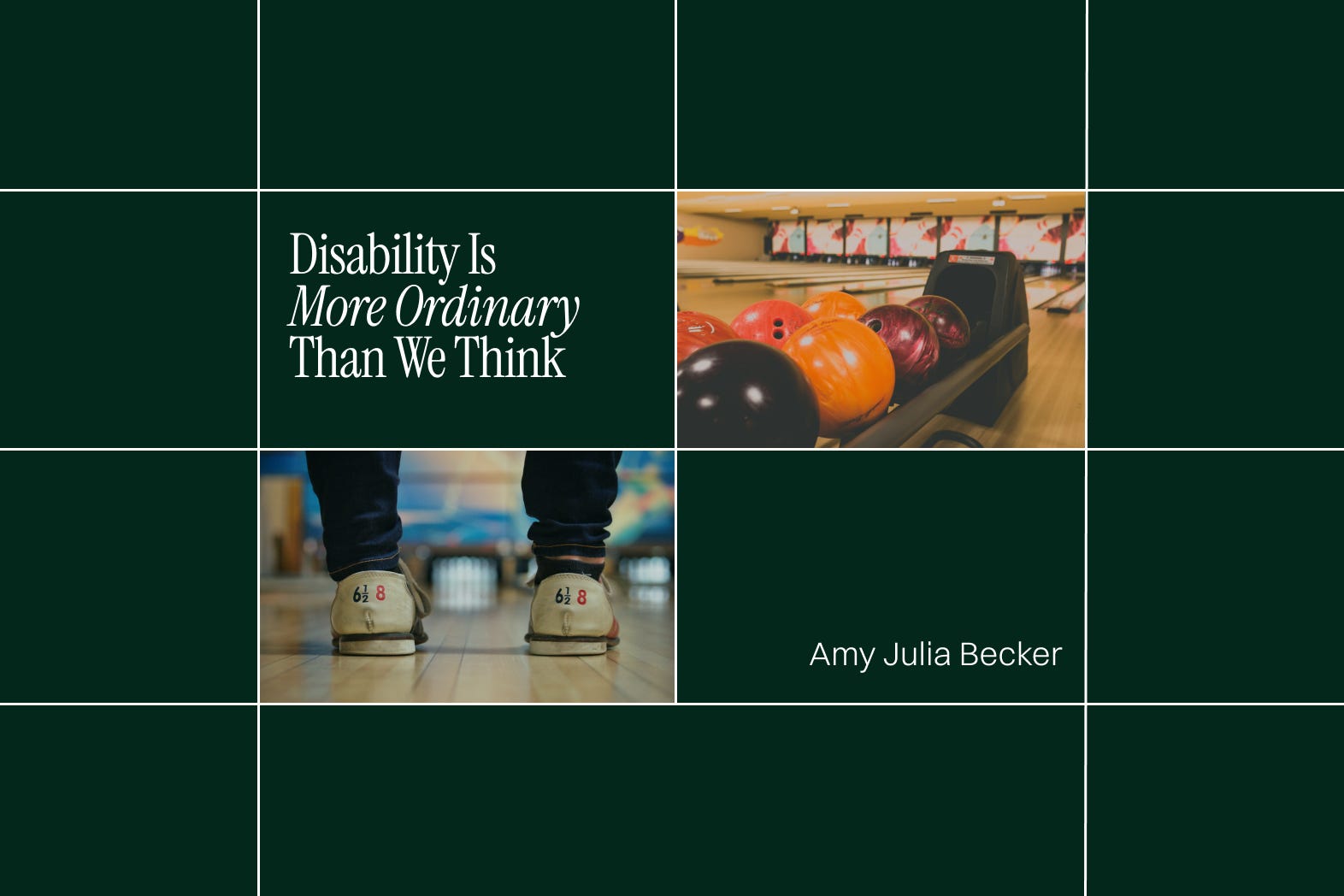
So on a drizzly Saturday morning, Penny sat in the passenger seat as we pulled up to the bowling alley. Penny and I had arranged a gathering of young people from her program at a local college. I felt a little unsure. I didn’t know these students or their parents. I sometimes still wonder what other young adults with disabilities will be like and whether I’ll know what to say and do.
I didn’t need to worry. Luke, a young man from the program, stood in the parking lot when we arrived. He shook my hand, looked me in the eye, and thanked me for organizing. He ushered us inside, then asked with enthusiasm, “Do you like chandeliers?”
One by one, the students came in, giving Penny hugs, hellos, and handshakes. Some rented bowling shoes. Some bowled in their socks. They cheered for each other. No one seemed to care about the score.
These young people all have parents who had at one time been like me, receiving an unexpected diagnosis for their children and wondering what hardships lay ahead. Now, it’s the ordinariness of gathering with friends to go bowling on a rainy Saturday, the ordinariness of our experience of disability, that feels like a surprise.
Disability felt anything but ordinary in the early days. As a new mom, I read scientific literature about Down syndrome with words like abnormality, disorder, and birth defect. I gathered statistics about all the things that might “go wrong.” I compared myself to moms who didn’t have a host of specialist appointments for their newborns and never learned the route to the children’s hospital by heart.
Until Penny was born, I understood disability only through what scholars call the medical model, where any condition deemed a disability is seen as a problem to be fixed. This medical perspective can be helpful; I’m grateful for the heart procedure Penny had at 14 months old and for the ways similar surgeries and medical advances have contributed to people with Down syndrome living nearly twice as long, on average, as they did 50 years ago.
For a while, I thought that if we worked hard enough to address Penny’s deficits, she might catch up. I saw the ways she deviated from the norms handed to me by growth charts and developmental milestones as problems to fix, rather than wondering whether the problem lay within my desire to measure her value based on her adherence to a graph, the timing of her first smile, the month when she sat up, crawled, or walked. The medical model pervaded everything. And, according to that model, she was failing. We were failing.
But that limited view did not make sense of our experience. In plenty of ways, Penny was just like a typical baby: She nursed. She woke us up in the night with her cries. She calmed in our arms. She sat up. She drooled. She giggled. She loved books and music. She drew people to her with her big blue eyes, and round, rosy cheeks, and her wave, accompanied by a breathy “Hi.” If I ignored the timelines and paid attention to my child, most days, it felt very ordinary.
The medical model of disability had led me to think that a genetic condition like Down syndrome, one that would never be fixed, meant Penny was broken. But she was not a defective product. She was not a problem sleeping in our arms. She was our beloved child. Her existence was not shameful but delightful.
Because a medicalized approach to disability focuses on addressing physical impairments, I, like many others, equated disability and suffering, as if they were the same thing (think of how often people refer to others as “suffering from” Down syndrome or paraplegia or any number of conditions).
In reality, much of the suffering related to disability could be alleviated through connection to and care from the community. Yes, suffering can be a visceral and long-lasting reality for disabled individuals and their families, but suffering has also always been part of the human experience. Suffering has always been an invitation for us to become more connected, more compassionate, and more civilized.
In The Dignity of Dependence, Leah Libresco Sargeant tells the story of a burial site in Vietnam from more than 4,000 years ago that includes the remains of a young man with tight limbs and fused vertebrae. She writes, “The respectfully buried bodies of adults with severe disabilities are the archaeological trace of civilization.” The evidence from these ancient bones bears witness not to this man’s suffering but to the community that fed and carried him, that welcomed him.
By some reports, 4% of the children in the United States count as disabled. Others put the number as high as 17%. (Statistics related to adults range from 13% to 25%.) This vast range shows just how flexible and broad the term disabled can be. These statistics point toward the reality that most of us—if we live long enough—will experience cognitive, emotional, or physical disability at some point in our lives. We will break bones, use hearing aids, wear glasses, walk with canes, get brain fog, lose memory. And all of those things will happen amid ordinary lives of eating meals and meeting up with friends and watching snow fall and rocking grandchildren and celebrating anniversaries.
We use the language of “special” needs when describing children with disabilities. And yet, the need for friendship, mobility, housing, meaningful work, agency, love—how unusual are these needs?
In his memoir, An Ordinary Future, anthropologist Tom Pearson writes, “Disability … is not merely a form of diversity, just another identity in a multicultural world. It’s a fundamental reality of the human experience shared in some way by all of us.”
The medical model has seeped into our broader cultural assumptions around disability. We encounter a narrative of disability as a problem that needs fixing and a problem that is located within individuals, rather than as a natural human condition that invites respect and care. The story of disability as problematic and shameful declares that our value is predicated upon our abilities and usefulness rather than our presence and relationships—it’s a narrative that threatens to dehumanize us all by making our vulnerability into a liability.
Another approach—the social model—says that disability is a product of social structures and biases. As a character in the upcoming film Being Heumann tells a wheelchair user, “You are not the problem. The stairs are the problem.” Both models can be helpful in understanding disability, but there’s a more foundational truth that disability points us to in its ordinariness.
We use the language of “special” needs when describing children with disabilities. And yet, the need for friendship, mobility, housing, meaningful work, agency, love—how unusual are these needs? My friend Katherine Wolf, Co-Founder of Hope Heals, experienced a brainstem stroke at 26. She has used a wheelchair ever since. She has double vision and is deaf in one ear. She once said to me, “My needs aren’t special needs. They’re human needs.”
Last week, I watched as Penny struggled to cut a cauliflower while helping prepare dinner. I asked if she wanted a hand, and together we pushed the knife through the cauliflower stems. She then spent 10 laborious minutes pulling it apart. If I had been sitting in her seat, I would have given up or growled out loud.
I asked, “Does it frustrate you that cutting the cauliflower is such a challenge?” “No,” she said, continuing her task.
“Can you think of any time in your life when you’ve been frustrated?” She shrugged. I can’t. I can’t think of any time Penny was on the brink of throwing an object across a room or erupting into tears or chafing at the very real human limitations that have caused me so much grief over my many years on this planet. She inhabits the world with far greater implicit awareness and acceptance of her human limitations than I do.
Of course, not everyone with disabilities exhibits the same patience as Penny, just as plenty of typically abled mothers aren’t as type A as I am. When I tell a story like this, I risk trading one false narrative around disability for another. Instead of disability as a problem, I can easily tip to the opposite view and set it up as inspirational, as if Penny and her peers experience peace and patience at all times.
In dismissing the medical model, I can imply that the suffering that can accompany autism or Down syndrome or cerebral palsy is only a manifestation of a broken culture. It does not serve Penny and her peers to ignore the hardship of living in a culture that does not value their contributions or to deny that they live in bodies and minds that often require more medical attention than the rest of the population.
My point is not to create a new social hierarchy in which people with intellectual disabilities are there to teach us and inspire us. My point is to challenge the narrative around disability. It is the narrative that sent disabled people to institutions for much of the 20th century and the one behind the abortions that follow many prenatal Down syndrome diagnoses today. It points us toward exclusion and erasure rather than welcome and belonging.

Disability is a natural part of ordinary humanity that most of us will experience, either temporarily or permanently. Vulnerability, need, and limits define us as humans right alongside possibility, interdependence, and the capacity to contribute meaningfully to the world around us. We need a different narrative around disability—one that honors human neediness through legal protections, classroom and workplace accommodations, and care. We need one another, and we each have gifts to offer that will enhance us all.
Becoming a society that values welcome and belonging is more than a matter of justice. It is also a matter of mutual flourishing. If we can welcome people with disabilities, we can welcome the needy parts of ourselves. We can imagine a world where aging is not simply deterioration but a different type of growth and contribution. And we can imagine a society that welcomes children with congenital disabilities as contributors to our common life.
In the waning days of the Roman Empire, Christians surprised their pagan neighbors by rescuing disabled babies left to die of exposure. St. Augustine explained that the Greeks and Romans valued physical strength and beauty, but they often overlooked the qualities of human character that mattered most.
As Brian Brock relates in his book Wondrously Wounded, Augustine wrote that for all we know, these babies who looked different than expected could be “marvellous rarities.” Receiving the needs and the gifts of disabled people could help us experience ourselves, and one another, with wonder. It could call forth compassion and celebration. We could both expect and take delight in the diversity inherent within our bodies and minds.
I once thought our days would be filled with grief. I feared Penny would suffer. I worried we wouldn’t love her enough. I wondered whether our world would become small and sad. But none of those fears have proved true.
When Penny was born, I understood that hardship would be a part of our family’s story. I didn’t realize it would also be a life full of unexpected wonder, beauty, and joy. If there’s anything I’ve learned over these years of raising Penny and participating in the community of families affected by disability, it’s just how ordinary disability can be.
Praxis Press features essays from writers, founders, and culture makers offering creative responses to the major issues of our time, which we call Opportunities for Redemptive Imagination (ORIs).
Amy Julia Becker invites people to rethink the good life through her writing and speaking on disability, faith, and culture. She hosts the Reimagining the Good Life podcast and is involved in Praxis’s Disability ORI.
What a beautiful set of reflections. Will be thinking about these for some time to come. Thank you.