


We’re sharing some of our favorites from the Praxis archives here on Praxis Press. The following article was written in 2023 by Scott Kauffmann, Venture Partner and former Partner for Content, in collaboration with Andy Crouch and RuthAnn Deveney.
How do you capture a complex set of ideas and practices in a single adjective? The trick is to place an idea at the center that connects to other adjacent ideas in interesting ways. Think about conscious capitalism, impact philanthropy, child-centered education, lifestyle business. We have green dentistry, slow food, fast fashion, guerrilla marketing, and lean startups.
This challenge is notable within the Christian community. Ultimately to be Christian is to share a common center—Christ. But to do strategic work in the world requires clear and compelling differentiation. In our work at Praxis we frequently encounter adjectives like Christ-centered, gospel-centered, kingdom-building, faith-driven, biblical, missional, orthodox, disciple-making, Spirit-filled—and we affirm them all. Put any of these in front of “entrepreneurship,” and we would say without reservation that it describes the aim (and, we hope, the reality) of our community.
The name we’ve given to our mission—redemptive entrepreneurship—draws on all these theologically rich ideas, while bringing particular convictions to the center of attention. Our main goal, of course, is right there in the word “praxis,” the Greek word for “action,” putting ideas into practice. We’ve found that the word redemptive is exceptionally good at helping people put their faith into action in a complex world.
Redemptive does this in at least four ways: It forms, it challenges, it elevates, and it bridges.
Redemptive forms by giving us a pattern to follow in our work.
In God’s great story of Creation, Fall, Redemption, and Restoration, Christ’s redemptive work—his creative restoration through sacrifice—is the hinge of it all, the place where the action turns. The Redemptive label helps Christians enter and remember that story and see how we are implicated in every part of it: We can create because God designed us to; we are fallen and have been redeemed in love; and God has done this (in part) so that we can participate with him in the restoration of all things.
By locating our life’s work inside this story, we’re moved and motivated; our reason and imagination are engaged; and we’re led to build habits and practices that help us play our part in the story. Christ’s work to save the world sets a pattern we can follow to serve the world.
To us, this story-pattern captures the essence of our vocation in an even more powerful and actionable way than saying (for example) we seek to “honor God” or “bring the kingdom” in our jobs; or even to “work according to biblical principles” or “integrate our faith and work.” All these formulations are biblical and helpful, but we have found that the Redemptive idea has greater motivational and formative power for us and most people we encounter.
So Redemptive forms us through a pattern containing all these moves: It places our work in a story: God is redeeming all things—in us, for us, and in a limited but real way, through us. It calls out a motivation for our work: we love others because he first loved us.
Christ’s work to save the world sets a pattern we can follow to serve the world.
It gives us a reason for our work: the world is broken and needs repair, and that’s part of our job. It activates our imagination for our work: what might repair look like in this area of the world? It spurs us to action in our work: we create, build, risk, cultivate, sacrifice, restore.
Redemptive challenges beyond the Exploitative and even the Ethical in our work.
Redemptive draws on the story at the heart of the Christian faith; yet being a “Christian leader” is no guarantee of acting redemptively. Indeed, we all know of Christian leaders (and organizations) who fall into Exploitative patterns: seeking their own gain at the expense of others; building a brand or persona of trust while privately and knowingly violating that trust; falling for the “nobility trap” of manipulating people and evading accountability in the name of our rightfully noble aims—all in the name and pursuit of good things, even godly things.
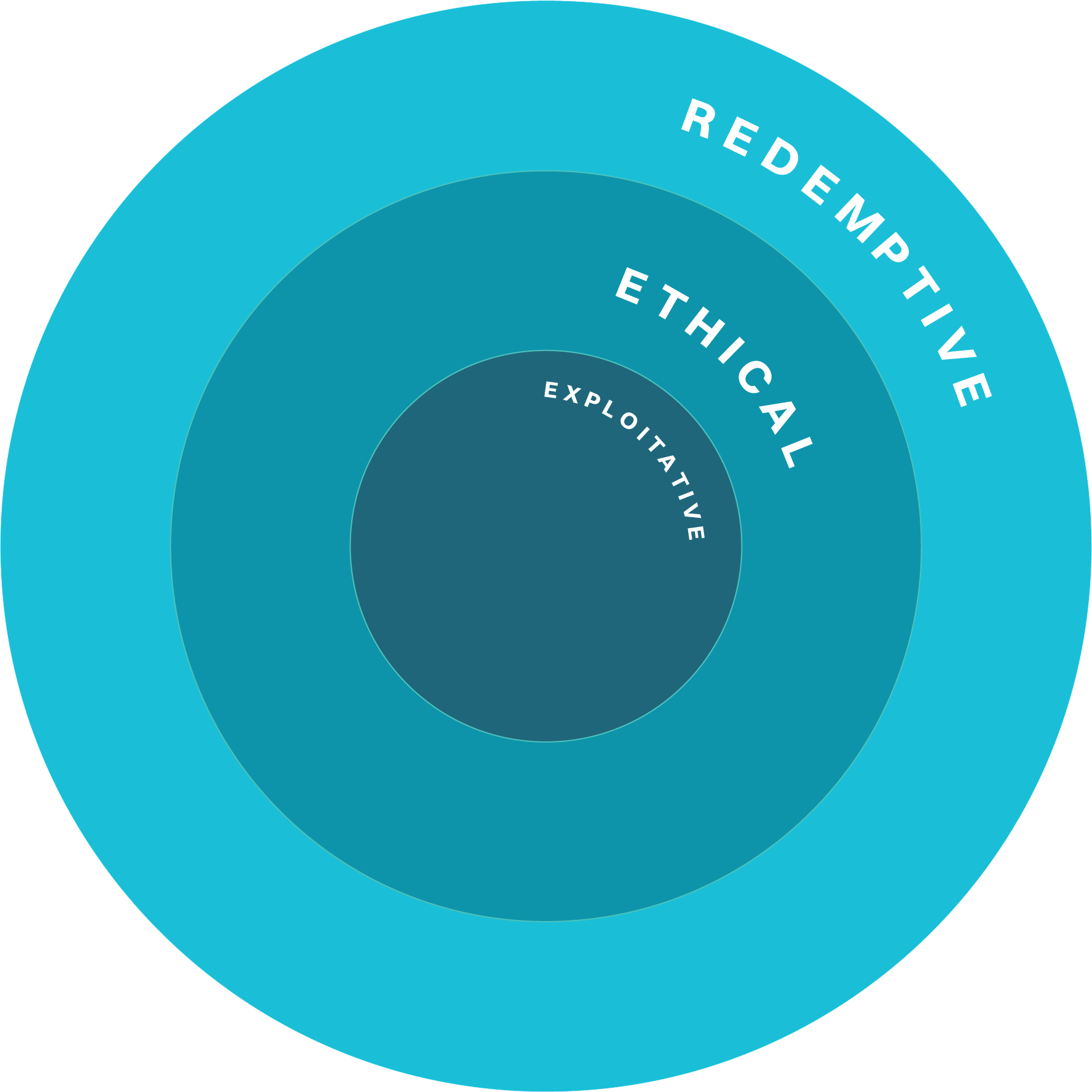
That we can fall into Exploitative patterns is what our theology of sin and human nature would lead us to expect. Selfishness—the hallmark of the Exploitative—is the default human approach to the world. As fallen creatures we seek our own glory, our own will. We turn good things into ultimate things and pursue these idols instead of God, for they easily promise us what we deeply seek: approval, comfort, power, and control. We are all partially blind to these patterns in our lives. So, though no one sets out to operate in an Exploitative way, no one—regardless of their faith commitments—is immune to actually operating that way some of the time.
“Christian”—as the saying goes—is indeed a wonderful noun and an almost meaningless adjective. We need reminding that we will be known for our fruit (Matthew 7:16) and not for our faith label.
Redemptive reminds us and challenges us that the Exploitative way is always available to us, lurking in our blind spots to tempt us, no matter what kind of spiritual pedigree we may carry.
When we introduce entrepreneurs and leaders to the Redemptive Frame, the first uncomfortable truth we teach is that we are also implicated in the Exploitative way. In addition to lamenting the brokenness around us, we will have to root out and repent of the places in our own life where we may be taking advantage of others (even unwittingly) by living for ourselves. Redemptive reminds us and challenges us that the Exploitative way is always available to us, lurking in our blind spots to tempt us, no matter what kind of spiritual pedigree we may carry.
Though we all lapse into the Exploitative way, almost all people set out to work in an Ethical way. Christians, certainly, rightly believe that our faith directs us to work with integrity and honesty; to do no harm in our organizational lives; to treat others with respect and fairness; to go above and beyond in work ethic and service; to invest in good causes including ministries; to partner with people we can trust; and to pursue excellence in everything we do.
This high calling to a profoundly Ethical standard is vital for the person of faith. As Tim Keller puts it in Every Good Endeavor,
If God’s purpose for your job is that you serve the human community, then the way to serve God best is to do the job as well as it can be done.
Redemptive stakes its claim on the idea that our world-story as Christians gives us the resources to work through and beyond the Ethical as an expression and demonstration of the gospel. The Redemptive way is a bet that as we grasp our true identity in Christ, we can trust him enough to tolerate more risk for the sake of others; that we can dare to act not only with respect and kindness, but with grace and even love; that we can operate not only in mutuality and fairness but in generosity and even sacrifice.
To be Redemptive, then, is to be always Ethical—and sometimes noticeably, maybe even radically more than that. We can always make our work a demonstration of the (redemptive) power of the gospel, whether or not it ever involves a literal declaration of that gospel.
Redemptive elevates by addressing all three dimensions of work.
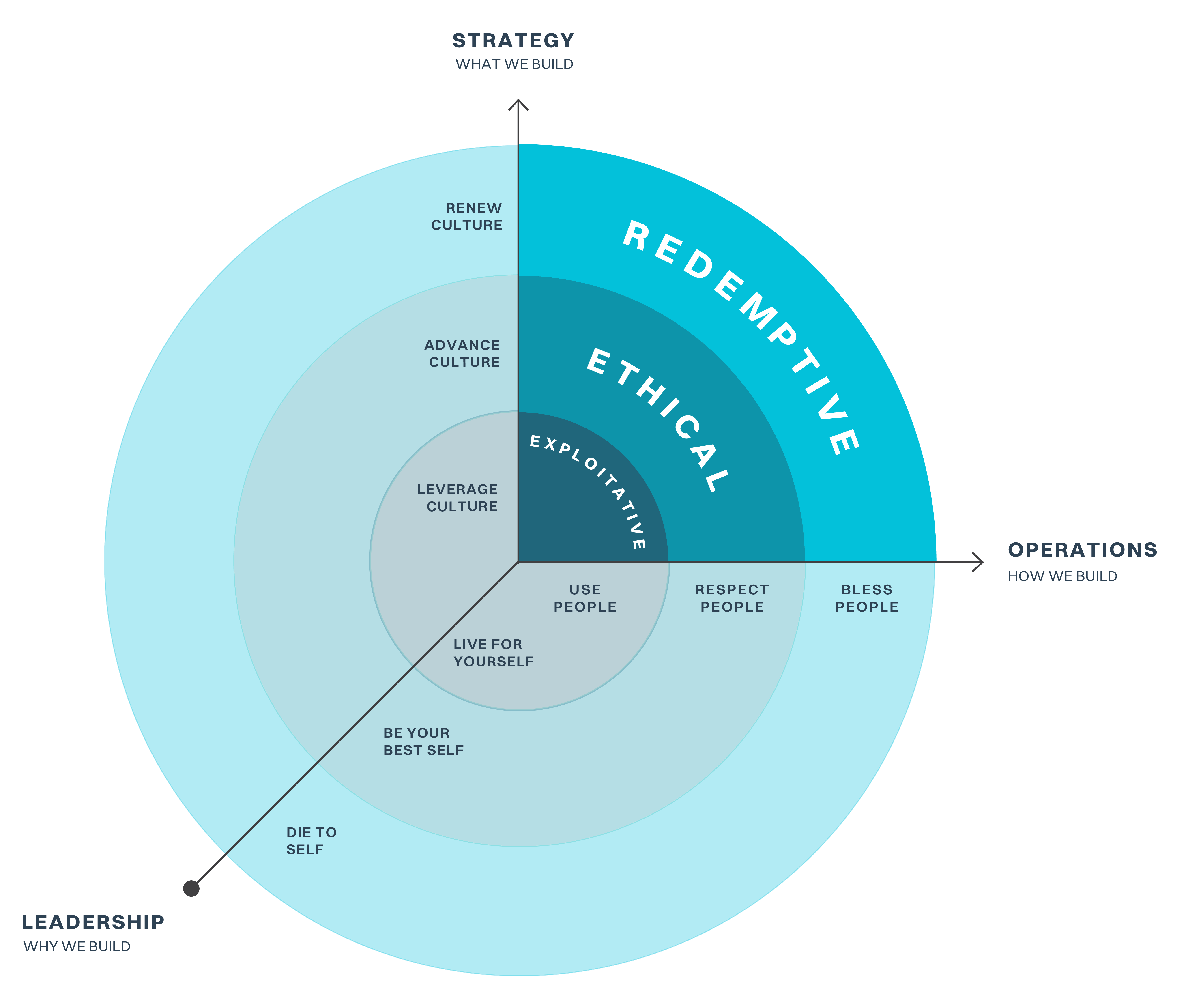
The 3 Dimensions of Work in the Redemptive Frame, as applied to organizations, are:
Strategy—what we build in the world to create value for stakeholders
Operations—how we build by organizing people, processes, and resources to deliver the strategy
Leadership—why we build as leaders, pursuing some “script” for success and identity
Here we focus on the Strategy axis—the cultural impact of our work. Many serious Christians care a good deal about why they work, and about how they work, but many don’t reserve the same kind of attention for what they work on. They want to do things they find interesting and that are not harmful to the world, but that may be the end of their imaginative ambition in this area.
Yet what we work on—and how its effects ripple through the culture—is indeed a great missional opportunity for the church in this cynical and suspicious age. Are the products and services we offer humanizing and lasting, or are they addictive and fleeting? Do our brands and stories appeal to our virtue and hope, or to our fear and desire for status? Do they contribute to delight and contentment, or are they engineered to overdeliver margin and underdeliver value? In the end, do we build cultural products in order to join God in the renewal of all things, or merely to do no greater harm to the world than our competitors?
Yes, these questions of cultural consequences will take on different meanings for an insurance adjuster, a baker, a filmmaker, and a nonprofit worker. But they apply to all those people in some way. Redemptive culture making is not the domain of just the “social entrepreneurs,” artists, and humanitarians. To believe this—and many people today seem to do so by default—is to fall into another form of the old sacred–secular divide where “ministry” work was seen as higher than all other kinds of work. There is ministry in all work—especially if those doing the work are intentional not only in how and why we do our work, but also in what happens to the world because we are at work in this way.
In the end, do we build cultural products in order to join God in the renewal of all things, or merely to do no greater harm to the world than our competitors?
There is a redemptive edge to oilfield services and car washes, just as there is for foster care and workforce development. It just takes an uncommon kind of imagination to see these possibilities.
Redemptive bridges to the story behind our work.
Redemptive is not exclusively for Christians; it also offers an invitation or bridge to those around us.
As Christians in a pluralistic society—in Babylon, not in Jerusalem, we might say—we face a missional paradox. Our ultimate allegiance is not to this world, but we are to pray and work for the peace and prosperity of our “city” (Jeremiah 29:7). We gather in the community of faith for formation, fellowship, and preparation, but then we are sent out to serve and love people who do not share our faith.
It’s natural that our public language should reflect this paradox. Generally “faith language” doesn’t come up often at work. Yet there are many times in our work lives, especially as leaders, when we appeal to a cause, a set of values, an ethical standard. In those moments we have the opportunity to communicate and translate our core commitments—giving a reason for the faith that is within us (1 Peter 3:15) in a way that serves as invitation rather than exclusion.
We are likely to be at our most faithful and effective in our mission when our commitments, practices, and language are both familiar and strange to others.
When we explain our motives, practices, or commitments to a friend or colleague, and we say we’re seeking to drive progress, advance the common good, follow a just cause, do the right thing, or be values-based, those terms are familiar but not strange. They will certainly be the right things to say in many settings, but at other times we may be missing opportunities for transparency and witness.
On the other hand, if we were to define our motives or commitments to those around us using theological terms—for example, that we want to be missional, Christ-centered, or gospel-centered in our work—that language may be appropriate in certain settings. It certainly does the first job of naming, to clearly define our center, but it also creates boundaries in a way that is likely to feel exclusive to those around us. It sounds like we’re saying, “I define my work according to my tribe, which doesn’t include you.” It’s strange but not familiar.
Using language like “redemptive” to describe our personal or organizational purpose can work as the church is meant to work in the world—as a witness, a demonstration, an invitation to an unseen and life-changing reality.
The term “redemptive” strikes us as the ideal combination of familiar and strange. While it may feel vaguely religious to some, it also has vaguely universal appeal. People know they respond to redemptive stories—even though most couldn’t explain what they mean by the term. So using language like “redemptive” to describe our personal or organizational purpose can work as the church is meant to work in the world—as a witness, a demonstration, an invitation to an unseen and life-changing reality.
The point here is not to convince you to use the term “redemptive” in your work. Many people in our community have found it very helpful; others prefer to translate using other words. The key is to consider “familiar yet strange” language that builds a bridge to others in pursuit of purpose. Just that step can itself be a small redemptive act—taking a risk to create new space for trust, so that anyone and everyone can bring their deepest convictions into their work.

