

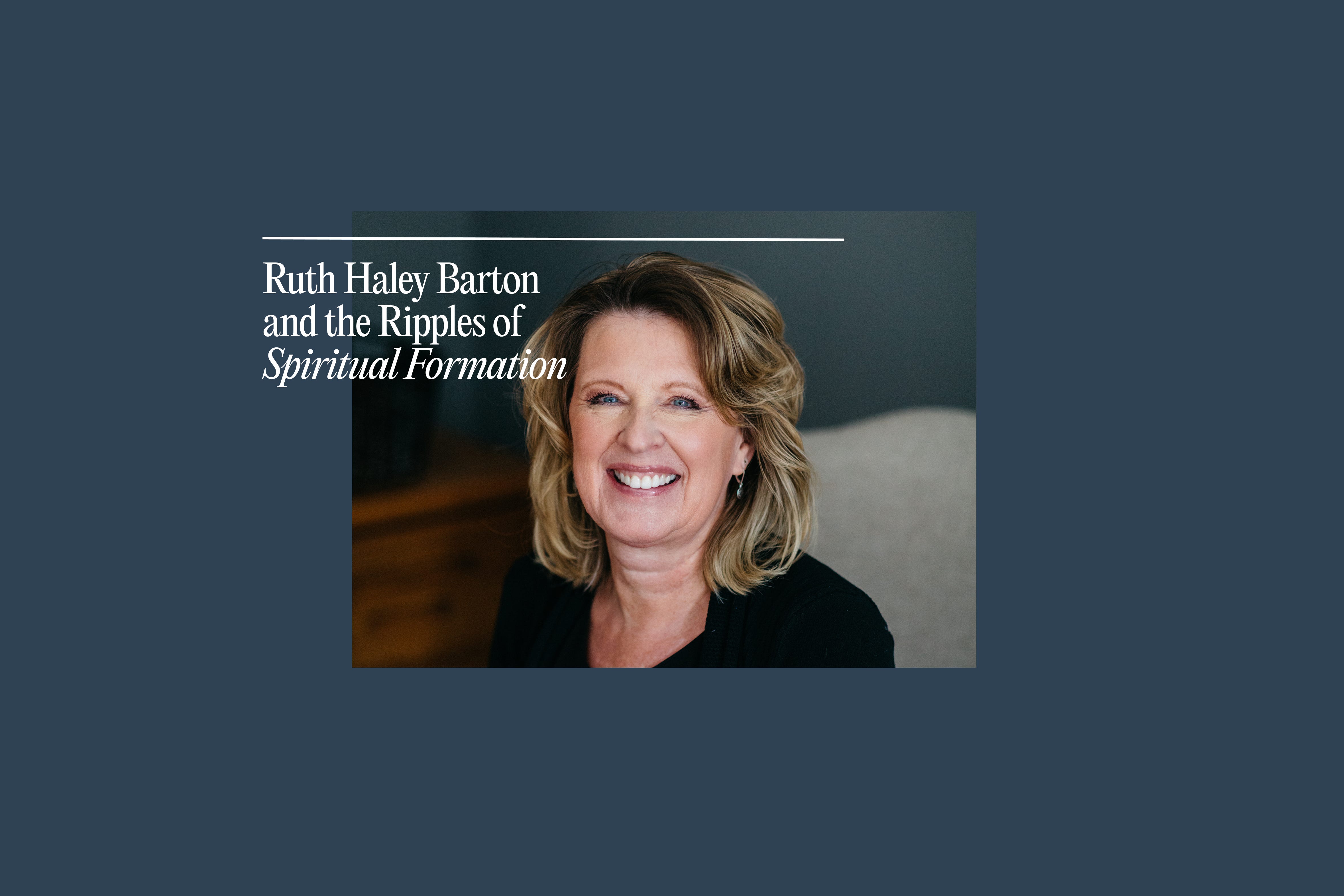
Spiritual formation doesn’t just happen during our quiet time.
Over her career, Ruth Haley Barton, spiritual director, author, and founder of the Transforming Center, a ministry dedicated to strengthening the souls of Christians in leadership, has seen formation move in concentric circles, “starting at the center in solitude, moving to the community that sustains us in the mystery of our faith, and finally to ministry and mission, where we’re in God for the world.”
That makes formation a leadership question. A community draws from the spiritual formation of its leader, just as a leader is formed and transformed in community.
“Jesus is so clear that the kingdom of God is here now, if we can find ways to open to it and access it,” she says. “To me, that’s what spiritual transformation is: a life of surrender to the reign of God in our lives. It’s much more central than a set of electives or a retreat center somewhere.”
Barton spoke with Praxis about sacrifice, calling, organizational drift, her new book, Leading a Transforming Community, and her upcoming year of jubilee.
This interview has been edited and condensed for clarity.
You’ve said the best thing you bring to leadership is your own transforming self. What does that look like to the people being led?
You have a leader who is clearly living sane rhythms of work and rest, including Sabbath. That’s a very public thing. They take a Sabbath, everybody knows when it is, and nobody would consider violating it. Then, based on their own need and experience, they lead their congregation into rhythms of work and rest. A transforming community is by definition a Sabbath community.
I also think that a leader who is connected with their soul is actively discerning. One pastor who came through our Transforming Community experience, he’s a Presbyterian minister, and he began to invite his elders into discernment. It was a 100-year-old church, and they said, “You’re the first pastor who has invited us to discern anything with you.”
And there’s an appropriate kind of vulnerability. There are boundaries for that, but rather than everything being about polish and professionalism, there’s a willingness to be human. That leader is finding themselves fully accepted in God’s presence, and they’re not looking to performance to shore themselves up. So they’re freer to bring their authentic self to those they lead.
What usually moves a leader to seek deeper spiritual support? Does it take burnout?
Burnout or being very tired can contribute to that. But when we are involved in mission and in what God has given us to do, there will inevitably be times when we hit our own human limits or even experience a failure, and we realize we need more interior resources.
In the early part of our lives, we do what we do in response to a loving God, but we also have a lot of our own human effort and activism and energy wrapped up in it. There will come a time for all of us when we hit the limits of that way of doing it. That’s when people come and want to know how to dig a deeper well, or a deeper canal for the presence of God to flow into their lives.
A lot of times failure happens because we’ve gotten disconnected from our souls, from the place where God is present to us. Whether it’s hitting our limits and realizing, “I’ve been doing this in my own strength for so long and I just don’t have any more,” or whether it’s an actual failure, either one produces an awareness that we need more of God than we have right now.
At Praxis, we often describe redemptive work as “creative restoration through sacrifice.” What role should sacrifice play in a Christian leader’s life?
First, we need to be really careful with that idea. I was raised in a pastor’s home, and I know what sacrifice was. I think we sacrificed way more than we should have as a pastor’s family, and I don’t think our dad stood up enough for what we needed. So I feel almost cringey about it.
So how do leaders model sacrifice without setting an expectation that they’ll carry more than they were meant to hold?
Jesus’ life did lead to the ultimate sacrifice, with smaller sacrifices along the way, but Jesus’ life also models self-possession. He didn’t heal everybody who needed healing. He didn’t let himself be crucified any old time. He melted through crowds when they wanted to kill him. He didn’t make that ultimate sacrifice until God told him it was his time, and they wrestled with it. He went up the mountain to pray when he got tired and before important decisions. And he says in John 10, “I lay my life down of my own accord, and I will take it up again.”
We have to be careful not to use victim-type language in subtle ways, or to have an imbalance between our own needs and the needs of others. It’s about attunement to God and to what God is actually asking of us, versus what other people expect of us or what our role expects. Much of that is cultural: the idea that a leader is supposed to be available 24/7 and doesn’t need rest the way other people do. The whole thing, in my mind, is being in tune with God for when God says, “This is a sacrifice I’m asking you to make.”
Some sacrifices are healthy, though, like giving up reputation or productivity to keep a Sabbath. How do you tell the difference?
That’s why discernment is so key. We could sacrifice everything forever, and it still wouldn’t get everything done that needs to be done on this earth. We have to discern, as individuals and as communities, what is ours to do, and what is ours to do within the rhythms of work and rest God has ordained for us.
The Sabbath rhythm is God-ordained. God told us we need it and never took it back, as far as I can see. So I don’t know how so many in Christian service feel like the instruction to Sabbath is something they can kick to the curb, when it’s so clear, both from God and from how Jesus lived his life.

Calling can motivate faithful work, but it can also push us to pursue the work at all costs, even ahead of God. How should leaders think about calling?
How many times have I heard a pastor say, “I’m leaving this church because a larger church has called me”? Our pastoral vocation becomes about succeeding in very external ways, rather than “God has called me to be faithful to this community.” We’re as subject as anyone else to looking for promotions and outward signs that we’re successful.
I think calling has three elements, in this order. First, we’re called to be the person God created us to be uniquely, as God’s creative effort, and not to work against that. Second, we’re called to belong to the One to whom we belong, the One who created us, and to cultivate that relationship of belonging. Only third does calling have anything to do with outward vocation or doing anything. If it goes in that order, there’s a much higher likelihood that we’ll end up doing vocationally what we were created to do, what fits us, and what makes it possible for us to keep cultivating that relationship of belonging with God.
That three-pronged definition of calling is very meaningful to me. It’s all on God: how God creates you, what God brings out of that relationship of belonging, how God calls you in a very personal way. Then the outward measures of success aren’t as meaningful, because you’re not always looking for bigger and better and up and to the right. You’re looking to live as your authentic self in God, responsive to God, with a deep sense of your identity and belonging, and what you do comes out of that.
Over 25 years, have you felt market pressure on your own work: to scale, to reach more people, to grow revenue?
Yes, definitely. My title has been founder and chief essence officer, and part of my role has been to help us stay faithful to our essence amid the other pressures: financial sustainability, taking it to scale. There are always people with ideas about that. There were times when I was younger when I wished we were bigger or more than we were. But every time we tried to move in that direction, we saw that it compromised us on the level of essence, and I would say identity. We talk about mission drift, but I also think there can be identity drift. Who you fundamentally are can drift, and all of a sudden you’re something you never set out to be.
The truth is, I founded this organization to be a community. I never even wanted it to be an organization. So sometimes I get the heebie-jeebies when we talk too much about organizational strategy, because it’s never what I set out to do. I’d already been in big places where we had done all that, and it didn’t hold an attraction for me anymore. I knew how empty it could be at the center of it all.
You have a long sabbatical coming up. I wanted to ask a question I heard from International Justice Mission founder Gary Haugen: How do you attend to your own inspiration?
I think it has to do with being able and willing to be in touch with your deepest desires and longings, and to trust that there’s something in that that is good and that God actually wants for you too. One of the things I encourage leaders to watch for is when you are practicing Sabbath, but then Sabbath isn’t enough and you’re exhausted at the end of Sabbath and don’t want to go back into your life, that means a sabbatical needs to come. That means you need that longer period of time.
I’m actually going to take a year of jubilee. I’ve had the sabbaticals; they’re short compared to what I’m contemplating. But I’ve been in ministry for 50 years, and so I just feel very clear that that’s what God is giving me and wants me to take.
I love the idea of inspiration, but I also really feel that healing is something else that needs to be included in there, because we’re on the front line of spiritual battles all the time. So heading into a sabbatical time, ask: Is there anything in me that needs to be healed? Many Christians just soldier on. Something hard happens to them in one environment and they shove it down and go on to the next opportunity, and they put the brave face on it. But that thing is still there. I like to counsel around: Is there anything in your life that might need a healing touch from God, and what could we put around you for that? Even as we do these great things for God, we’re only human, and we take hits, and we need healing too.
I know many leaders have appreciated your book Strengthening the Soul of Your Leadership. How does that fit with your latest release?
Strengthening the Soul of Your Leadership was written to help leaders pay attention to their own interiority, to their own life with God, and to understand that the soul is the place where God is present to us and that spiritual leadership is going to originate and emerge from that place. Leading a Transforming Community is the next step. I hope people don’t get them out of order, because only leaders who have done the work internally around their own souls and motivations are going to be prepared to lead a transforming community with positional authority and inner authority.
One of the stakes I drive in the ground in the new book is the relationship between formation and mission. Early in my life in the formation world, there was this idea that if people are encouraged too much in the formation or the discipleship direction, they’ll stop caring about the needs of the world, and so churches began to identify themselves as missional communities.
In this book I attempt to bring those together. Transformation increases our capacity to discern the will of God, which becomes our mission, and we get out there and do the will of God. Then we hit up against limits or even failures, and we’re cast back on God’s mercy and the need for a deeper grounding in God. That’s a cyclical thing, not a static thing. It’s like a bicycle wheel that moves you forward. I’m hoping we could put that to rest once and for all, that division between formation and mission, because I think they’re part of the same process.
