

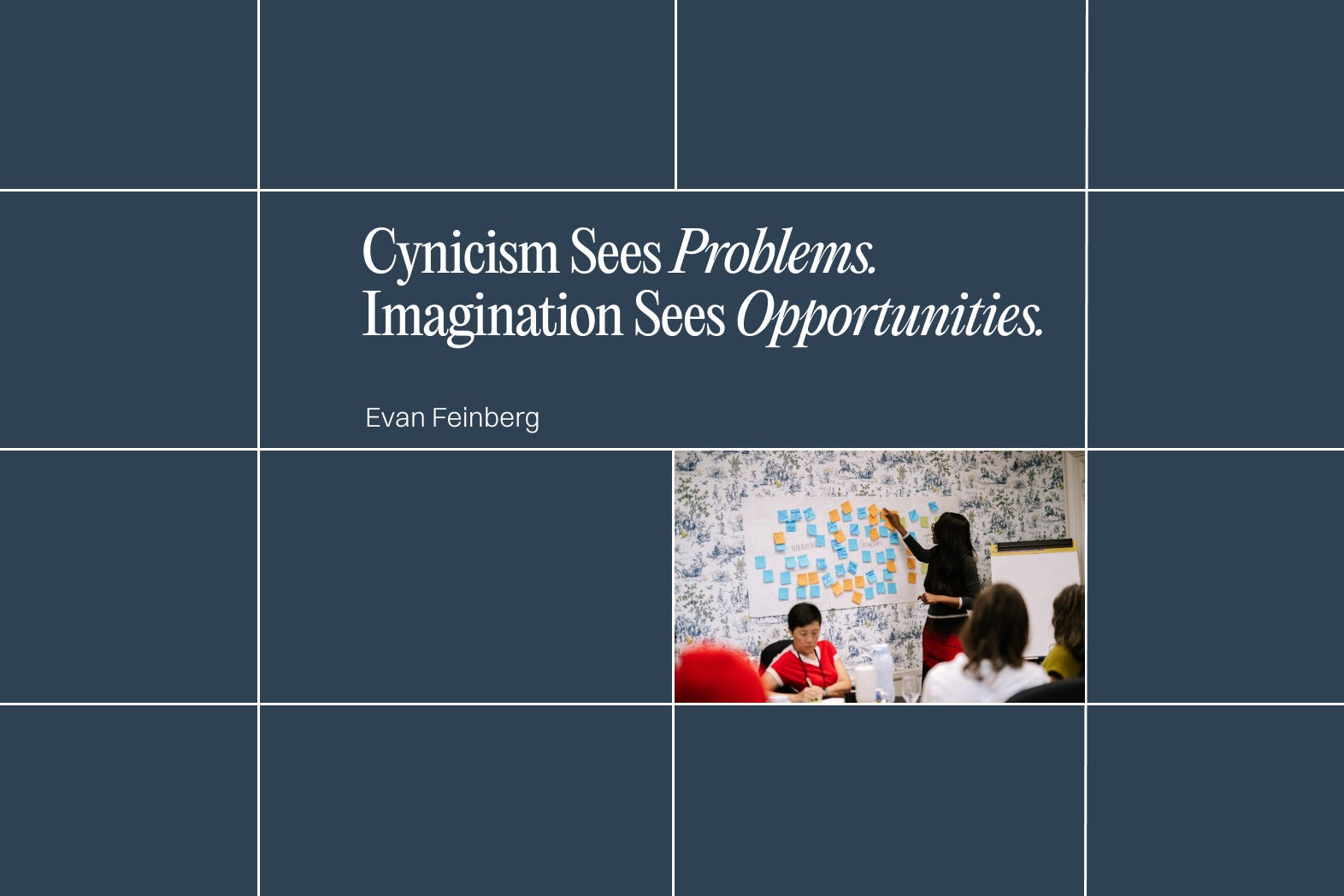
Among the first lessons young business students learn is that problems and opportunities are two sides of the same coin. On one side, a problem presents a challenge or an obstacle. But on the other? A problem is an opportunity to create value. If there were no problems in the world, we wouldn’t need entrepreneurship or enterprise.
Could Christians learn something from this basic understanding of business?
Unmanageable Problems
We live in a lonely, polarized world. Problems are everywhere, and at times it seems like things are only getting worse. We see broken systems all around us—poverty, injustice, healthcare, education, and so much more. And while technology promises to make us more creative and help us flourish, it also drives the dehumanization at the root of so many of today’s challenges.
These feel like unmanageable problems. As Christians, we may want to throw up our hands and disengage. Perhaps we’ll still pray for our broken world, but our hope in the return of Jesus leads to a kind of quiet acceptance, bordering on passivity. At its worst, this posture can bring about a spirit of cynicism.
Seeing the world with a problem mindset can also breed a more nefarious disposition. Faced with complex and connected problems, we look around for people to blame and seek power over others. We start to think, “If we could just grab more power—political, social, financial, or otherwise—we could set things right.” Rather than retreat, we try to conquer.
But neither disengaging nor seeking power is the redemptive way. They are not the way of the Cross, following Jesus’ pattern of creative restoration through sacrifice. When we choose to withdraw or to chase power, we inevitably fail to rise to the challenge of these complex problems. More than that, we forsake our vocation of bearing God’s image for the life of the world.
Opportunities for Redemptive Imagination
God calls us to be creative cultivators of this earth, to participate in his work to renew all things. We aren’t meant to sit on the sidelines, and we aren’t called into endless culture wars. We’re invited to be culture makers—those who live our faith by using our God-given creative faculties to make this world a better reflection of our Creator. Cultural renewal, in this way, comes about as the Spirit forms us in love of God and neighbor.
N. T. Wright says that our task as Christians is “to announce redemption to the world that has discovered its fallenness, to announce healing to the world that has discovered its brokenness, to proclaim love and trust to the world that knows only exploitation, fear, and suspicion.” In this way, he writes, “the gospel of Jesus points us and indeed urges us to be at the leading edge of the whole culture.”
With that in mind, we can reframe, like the young business students, today’s unmanageable problems as Opportunities for Redemptive Imagination. Paul tells us that we have “the mind of Christ” (1 Corinthians 2:16). A transformed mind can see the world not only as it is but as God intends it to be. Every intractable problem is a massive opportunity for God’s love to show through in a hurting world. Every act of faithfulness can serve as a demonstrated apologetic for this love, as we serve a God who cares for his people through his people, image restoring image.
We can also adopt a “design thinking” approach. Here, the constant refrain is to move quickly from a problem statement into a “How might we?” statement. This framing question was largely developed at IDEO and formalized at the Stanford d.school. It moves us from being stuck in the problem to a place of generative imagination and possibility. It’s a flip from indictment to invitation.
How might we restore belonging and extend true community to those without a home? How might we engage in politics and public life without losing our souls to partisan fighting? How might we offer robust, holistic approaches to address the mental health crisis of our day?
These might feel like huge questions, but this way of thinking doesn’t demand a single answer. If you can’t think of answers to these questions, I can assure you that there are hundreds of entrepreneurs who are already developing creative responses to them—I’ve met many of them through our work at Praxis.
Redemptive Imagination in Action
Over time, a set of Opportunities for Redemptive Imagination (ORIs) has emerged from our community at Praxis—issues where we believe collaborative innovation could be profoundly good news for our neighbors. There are now more than 30, organized into five pillars: Who We Are, Where We Live, How We Work, What We Face, and Where We’re Going. For each ORI, a network of humble and ambitious Christian innovators develops a shared Redemptive Thesis, then launches ventures and projects to make it tangible for the life of the world.
Take homelessness. You’ve heard it said that homelessness is a housing problem to be solved through services and shelter. Gabrielle Clowdus, founder of Settled, sees something deeper: At its root, homelessness results from a lack of family and belonging, a poverty of relationship that the Church is uniquely positioned to heal and redeem.
Or take our public life. You’ve heard it said that faithful public engagement means winning the right coalitions and policy fights, or that politics is a cesspool we must stay above. Michael Wear, president and CEO of the Center for Christianity and Public Life, sees political agency as limited but real, a gift to steward for those we oppose and those our politics overlooks—part of our calling to love God and neighbor. His nonpartisan institution forms Christians who bring joyful confidence, not anxiety, to the public square.
Or consider mental health, one of the most pressing issues of our time. You’ve heard it said that mental health is purely a medical problem, a malfunction to be diagnosed, managed, and fixed by professionals. In the Church, you may have heard the opposite—that if you just prayed harder, the darkness would lift. Daniel Whitehead, CEO of Sanctuary Mental Health Ministries, insists that you are neither a broken machine nor a spiritual failure, but a whole person. He is creating communities of deep belonging, places where you are known by your name, not your diagnosis.
These aren’t only ideas. We have a bias toward action over argument, and in the ORIs where we’ve been doing this work longest, consequential things are already being built in the world.
On artificial intelligence, a network of more than 50 builders has published a thesis on how AI could strengthen our humanity and launched a new venture studio based on that redemptive vision. On child welfare, Flourish Fund has raised and deployed significant capital for new approaches to caring for vulnerable children and their families. Each of these initiatives began when someone looked at a significant problem and asked, “How might we?”


How Might We?
Many redemptive entrepreneurs address only one aspect of a huge problem or serve a limited number of people in a specific geographical or cultural context. But every faithful answer is a little bit of heaven breaking through, a look at the world not as it is but as God intends it to be. Every time that light shines through, we get a glimpse of God’s love for the world, an icon of his cosmic redemption. The Spirit bears witness through our faithful actions.
Imagine a world in which hundreds of millions of Christians across the globe take small, faithful, creative actions, seeing major problems of our time as opportunities to show the love of Jesus.
That leaves me asking: “How might we awaken the creative and prophetic contributions of Christians to address the major issues of our time?”
Sounds a lot more like an opportunity than a problem.
Evan Feinberg is Praxis Partner for the Redemptive Imagination Project, organizing Christians to influence the major issues of our time.
Explore more about Opportunities for Redemptive Imagination in The Praxis Course.

